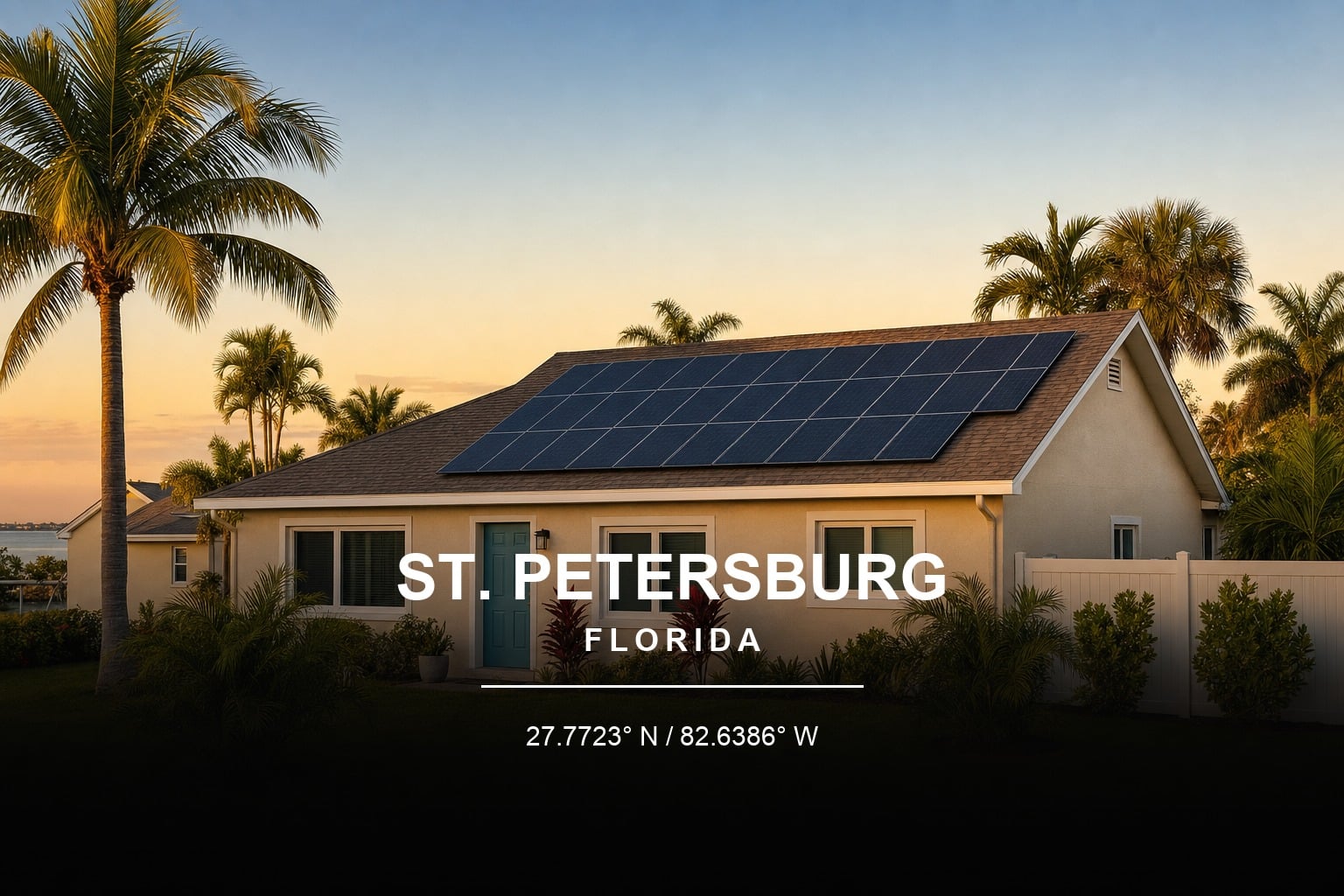
Solar Panels in St. Petersburg, FL: Duke Energy Florida, Tampa Bay Solar, and Net Metering in the Sunshine City

St. Petersburg is served by Duke Energy Florida — one of Florida’s four investor-owned utilities required by the Florida PSC to offer full retail-rate net metering. Duke Energy Florida serves approximately 1.9 million customers across central and north-central Florida, with St. Petersburg and the Tampa Bay area as its largest market. Duke’s residential rate is somewhat lower than FPL’s, producing a slightly longer payback timeline — approximately 10–12 years compared to Fort Lauderdale’s 8–10 — but St. Petersburg’s solar fundamentals are strong: 5.2–5.3 peak sun hours daily, year-round AC demand, and high-consumption waterfront and bungalow neighborhoods that support larger systems. Florida’s no-lease, no-PPA prohibition applies fully in St. Petersburg — cash purchase or solar loan are the only ownership structures. Duke’s TOU rate plans offer a meaningful peak/off-peak spread that solar production aligns well with during Florida’s long summer days.

Duke Energy Florida Net Metering: How St. Petersburg's Utility Credits Solar

Duke Energy Florida is required by Florida PSC Rule 25-6.065 to offer full retail-rate net metering to residential solar customers. Every kilowatt-hour St. Petersburg’s panels export to Duke’s grid earns a credit at Duke’s current residential retail rate. Credits roll forward month-to-month. At the end of the 12-month billing cycle, any remaining unused credits are paid at Duke’s avoided-cost rate — approximately 3–4¢ per kilowatt-hour. Florida’s 115% annual consumption sizing cap applies to Duke customers as it does across all Florida utilities.

Duke Energy Florida’s TOU rate plans offer a peak/off-peak pricing structure — peak rates run approximately 20¢ per kilowatt-hour during afternoon and early evening hours, while off-peak rates drop to approximately 7¢ per kilowatt-hour. St. Petersburg’s solar panels produce their peak output during midday and early afternoon — exactly when Duke’s TOU rates are elevated and solar self-consumption displaces the most expensive grid electricity. Duke customers on TOU plans can meaningfully increase their solar savings by shifting flexible loads (EV charging, dishwasher, laundry) to off-peak hours when grid power is cheapest, while solar handles the afternoon peak loads. Duke Energy Florida does not offer a direct residential solar rebate program in 2026; net metering and the state tax exemptions are the primary financial mechanisms.

St. Petersburg's Solar Market: Bungalows, Waterfront Homes, and Hurricane Resilience

St. Petersburg’s housing stock is one of the most varied of Florida’s major cities — a mix of the classic Florida bungalows of the Kenwood, Crescent Lake, and Historic Roser Park neighborhoods; larger waterfront homes in Shore Acres, Snell Isle, and Old Northeast; and newer construction across the South Side. This variety affects solar installation in meaningful ways. The city’s Craftsman and Spanish-Mediterranean bungalows, typically built in the 1920s–1950s, often have roof conditions that require careful structural assessment and sometimes roof replacement or reinforcement before solar installation. Older electrical panels in these homes may require upgrades to support solar interconnection. Experienced St. Petersburg solar installers account for these additional costs in proposals — homeowners should request a detailed site assessment that specifically addresses roof condition and electrical panel capacity before committing to a system design.

Waterfront and modern St. Petersburg homes typically have more straightforward installation conditions: newer construction, adequate panel capacity, and roof designs suited to standard racking systems. St. Petersburg’s peninsular geography — surrounded by Tampa Bay on the north and east, and the Gulf of Mexico to the west — means the city is one of Florida’s most hurricane-exposed markets. Battery storage for grid-down resilience during storm events is a frequently cited motivation for St. Petersburg solar buyers, as Tampa Bay’s risk from major hurricanes is one of the highest of any major U.S. metropolitan area.

What does solar cost in St. Petersburg, and what is the realistic payback?

Tampa Bay area solar installations run approximately $2.60–$3.10 per watt in 2026. A typical St. Petersburg system of 9kW–12kW costs approximately $23,400–$37,200 before incentives. Florida’s 6% sales tax exemption on solar equipment saves approximately $1,400–$2,230. The 100% property tax exemption (FL Statute § 193.624) prevents Pinellas County property tax increases from the solar installation. No federal residential ITC applies to 2026 cash or loan purchases. Older bungalow homes may incur additional costs for roof work or panel upgrades that should be factored into total project budget. At Duke Energy Florida’s current rate structure, cash-purchase payback for St. Petersburg systems runs approximately 10–12 years — somewhat longer than FPL territory due to Duke’s lower blended residential rate. Twenty-five year savings estimates run $20,000–$35,000 for well-sized St. Petersburg systems.

Frequently Asked Questions

Duke Energy Florida’s TOU plans can improve solar economics for St. Petersburg homeowners who can shift flexible loads to off-peak hours. The peak/off-peak spread — approximately 20¢ peak versus 7¢ off-peak — means that electricity consumed during Duke’s afternoon and evening peak window is worth significantly more to offset with solar than off-peak electricity. Solar panels produce their best output during midday and early afternoon, naturally offsetting much of the peak-hours load before the grid rate falls in the evening. Shifting shiftable loads — EV charging, dishwasher, water heater — to overnight off-peak hours reduces the consumption you draw from Duke at 7¢, while solar handles the daytime loads that would otherwise cost 20¢. The net effect can improve annual savings by $200–$500 compared to a flat-rate plan, depending on consumption patterns. Discuss TOU plan enrollment with your installer during system design, as the optimal system size and orientation may differ slightly between TOU and flat-rate optimization strategies.
St. Petersburg’s historic bungalow neighborhoods can support solar, but require more careful evaluation than newer construction markets. The most important pre-installation checks are roof condition and age (shingle roofs over 15 years old may need replacement before solar installation, as panels carry 25-year warranties and re-roofing under installed panels is expensive), structural load capacity (older roofs should be assessed for rafter and decking condition), and electrical panel capacity (60-amp or 100-amp panels common in 1920s–1950s construction may need upgrading to support solar inverter and interconnection requirements). A reputable St. Petersburg installer will conduct a structural and electrical assessment as part of site evaluation. Additional costs for roof work or panel upgrades are common in the historic neighborhoods and should be included in any realistic project budget. Systems that pass these assessments can be installed successfully and produce strong returns given the favorable Florida solar and net metering environment.
St. Petersburg under Duke Energy Florida produces 10–12 year payback estimates — somewhat longer than Fort Lauderdale’s 8–10 years under FPL, primarily because Duke’s blended residential rate is lower than FPL’s. Tampa Bay’s solar irradiance is comparable to South Florida, so the difference is utility rate rather than sun resource. St. Petersburg’s bungalow housing stock creates more installation complexity than newer suburban construction in Cape Coral or Tallahassee, which can add to per-watt costs and push payback toward the longer end of the range. The hurricane resilience motivation for battery storage is stronger in Tampa Bay than almost anywhere in the dataset given the metropolitan area’s documented vulnerability.
City of St. Petersburg has designated several historic neighborhoods — Kenwood, Old Northeast, Roser Park — where exterior modifications including solar installations may require review by the Historic Preservation Commission. For properties within designated historic districts, confirm review requirements with the City of St. Petersburg Planning & Development Department before installation. Installations visible from the street are more likely to require review than rear-facing installations. Choose an installer with St. Petersburg historic district experience to navigate any review process efficiently.

Not sure how to compare solar companies?

Before contacting installers, read our guide on how to evaluate proposals, warranties, and long-term support.

Solar Companies and Installers Serving St. Petersburg