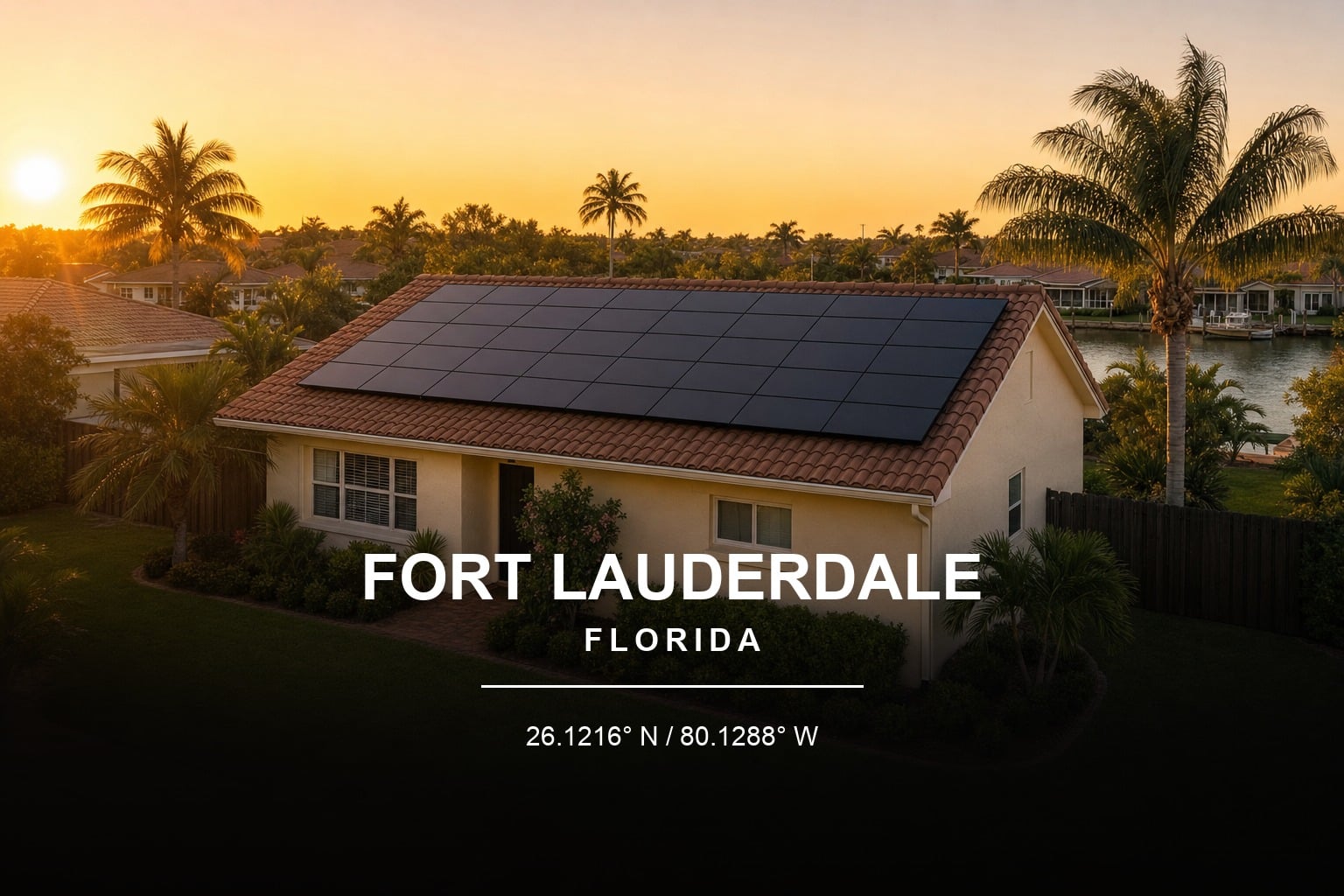
Solar Panels in Fort Lauderdale, FL: FPL Net Metering, South Florida's Peak Sun, and the Strongest Solar Payback in the State

Fort Lauderdale homeowners are Florida Power & Light (FPL) customers — the largest utility in Florida, serving approximately 5.8 million customers across most of the state’s eastern half and central region. FPL’s residential rate, combined with South Florida’s exceptional solar irradiance and the legal prohibition on solar leases and PPAs, creates the strongest pure solar ROI in the Florida dataset. Fort Lauderdale receives more than 5.3 peak sun hours daily on a south-facing tilted surface, the highest figure of any city in this state batch, and FPL’s net metering at full retail rate means every kilowatt-hour of midday solar production is worth the same as any other grid electricity at your billing rate. Florida’s sales and property tax exemptions apply, and the 2022 legislative attempt to weaken Florida’s net metering (which DeSantis vetoed) is a reminder that locking in interconnection under current terms has value.

FPL Net Metering: Florida's Strongest IOU Solar Program and How It Works

Florida Power & Light is required by Florida PSC Rule 25-6.065 to offer full retail-rate net metering to residential solar customers. Every kilowatt-hour Fort Lauderdale’s solar panels export to FPL’s grid during a billing period earns a credit at FPL’s current residential retail rate — approximately 13–15¢ per kilowatt-hour depending on the rate tier and time of year. Credits are denominated in kilowatt-hours and roll forward month-to-month throughout the year. At the end of the 12-month billing cycle, any remaining unused credits are paid out as a cash credit on the January statement at FPL’s avoided cost rate — approximately 3–4¢ per kilowatt-hour, well below the retail credit rate. Florida utilities require systems to be sized no larger than 115% of annual household electricity consumption; FPL enforces this limit as part of the interconnection approval process.

FPL does not offer a direct residential solar rebate program in 2026 — net metering savings and the state tax exemptions are the primary financial mechanisms. FPL’s SolarTogether community solar program provides an alternative for Fort Lauderdale residents who cannot install rooftop solar, allowing enrollment in a share of a larger FPL solar farm with bill credits at a modest discount rate. For homeowners with suitable rooftops, owned rooftop solar captures significantly more value than community solar subscriptions.

Florida’s prohibition on third-party solar ownership applies fully in Fort Lauderdale: cash purchase or solar loan are the only ownership structures. No leases or PPAs are available.

South Florida's Solar Advantage: Peak Sun Hours, Year-Round Production, and High Consumption

Fort Lauderdale’s location in Broward County gives it access to South Florida’s exceptional solar resource — consistently above 5.3 peak sun hours daily on an annualized basis, among the highest in the eastern United States. The subtropical climate delivers year-round AC demand that creates consistent monthly electricity consumption and a high baseline bill against which solar savings compound. Fort Lauderdale homes typically use 1,200–1,800 kWh per month, driven by year-round air conditioning, pool pumps, and electric water heating. This high consumption provides substantial monthly grid draw that a well-sized solar system can offset at FPL’s retail rate, producing stronger annual savings than equivalent systems in moderate-climate states with seasonal consumption variation.

Fort Lauderdale’s hurricane exposure also makes the conversation about battery storage more concrete than in most markets. While Florida’s strong net metering makes battery storage optional from a pure financial standpoint — unlike California under NEM 3.0, where battery economics are compelling — the resilience case for battery backup during hurricane season is a genuine and frequently cited motivation for Fort Lauderdale homeowners. Battery storage provides backup power during grid outages from tropical weather events, independent of any bill savings calculation. Florida has no state battery rebate program comparable to California’s SGIP, so the battery investment rests primarily on the resilience value and any FPL rate plan benefits.

What does solar cost in Fort Lauderdale, and what is the realistic payback?

South Florida solar installations average approximately $2.60–$3.10 per watt in 2026 in the Broward County market. Fort Lauderdale’s competitive installer base — with both South Florida regional contractors and national installers serving Broward County — produces pricing within this range. A typical Fort Lauderdale system of 9kW–12kW costs approximately $23,400–$37,200 before incentives, reflecting the larger system sizes Florida’s high AC loads require. Florida’s 6% sales tax exemption saves approximately $1,400–$2,230. The 100% property tax exemption (FL Statute § 193.624) prevents Broward County tax increases from the added solar value. No federal residential ITC applies to 2026 cash or loan purchases. At FPL’s rate and South Florida’s irradiance, Fort Lauderdale cash-purchase payback runs approximately 8–10 years — among the fastest in Florida and in this dataset. Twenty-five year savings estimates for Fort Lauderdale systems run $30,000–$50,000.

Frequently Asked Questions

Battery storage in Fort Lauderdale is primarily a resilience decision rather than a financial one. Florida’s full retail-rate net metering effectively turns the FPL grid into a free virtual battery — you export excess solar at retail value and draw it back when needed at the same rate, without the upfront cost of physical storage. From a pure ROI standpoint, adding a battery extends payback by several years relative to solar-only installation. The compelling case for storage in Fort Lauderdale is hurricane season: Broward County experiences regular tropical storm and hurricane impacts that cause multi-day grid outages. Battery backup provides power for essential loads during those outages — refrigeration, medical equipment, lighting, communications — with value that is real but not captured in standard financial models. If grid resilience during hurricane season is a priority, solar-plus-battery makes sense in Fort Lauderdale despite the longer payback. If pure ROI is the primary objective, solar-only at Fort Lauderdale’s strong irradiance and FPL’s rates delivers compelling returns without the battery.
In 2022, the Florida Legislature passed HB 741, which would have phased down net metering compensation for residential solar customers — reducing credits to below-retail rates on a multi-year schedule that would have significantly extended payback periods and reduced long-term savings. Governor DeSantis vetoed the bill, preserving Florida’s full retail-rate net metering intact. The veto was widely attributed to intense advocacy from the Florida solar industry and homeowner groups, plus the political optics of raising costs on existing solar owners. Full retail-rate net metering remains the law as of 2026, unchanged. The 2022 episode is worth knowing because it demonstrates that Florida’s net metering policy operates in a contested political environment — the legislative appetite to modify net metering has existed and may recur. Homeowners who interconnect under the current framework lock in their right to current net metering terms; systems installed and operating before any future policy change would be in a stronger position than new installations after a change.
Fort Lauderdale is Florida’s strongest solar market in this dataset by payback period (8–10 years), driven by FPL’s rate and South Florida’s irradiance. Miami has comparable economics under the same FPL framework. Tampa, St. Petersburg, and Jacksonville under Duke and FPL see 10–13 year paybacks due to somewhat lower irradiance and rate differences. Tallahassee under its municipal utility produces 10–13 year paybacks with the added benefit of the city’s low-interest on-bill loan program. Cape Coral under LCEC lands at 10–13 years due to the cooperative’s slightly lower rate. For pure financial ROI, Fort Lauderdale is the benchmark Florida solar market.
City of Fort Lauderdale building permits for residential solar typically process in 2–4 weeks. FPL interconnection adds additional weeks; plan for 6–10 weeks total from contract to system activation. HOAs in Fort Lauderdale are governed by Florida’s condominium and HOA law, which does not contain the explicit solar protections that Arizona, Nevada, and Texas statutes provide — Florida HOAs can restrict solar more freely than in those states, though egregious restrictions may face challenges. Confirm HOA solar policy before installation in any Fort Lauderdale community with a homeowner association, particularly in planned developments along the Intracoastal.

Not sure how to compare solar companies?

Before contacting installers, read our guide on how to evaluate proposals, warranties, and long-term support.

Solar Companies and Installers Serving Fort Lauderdale