
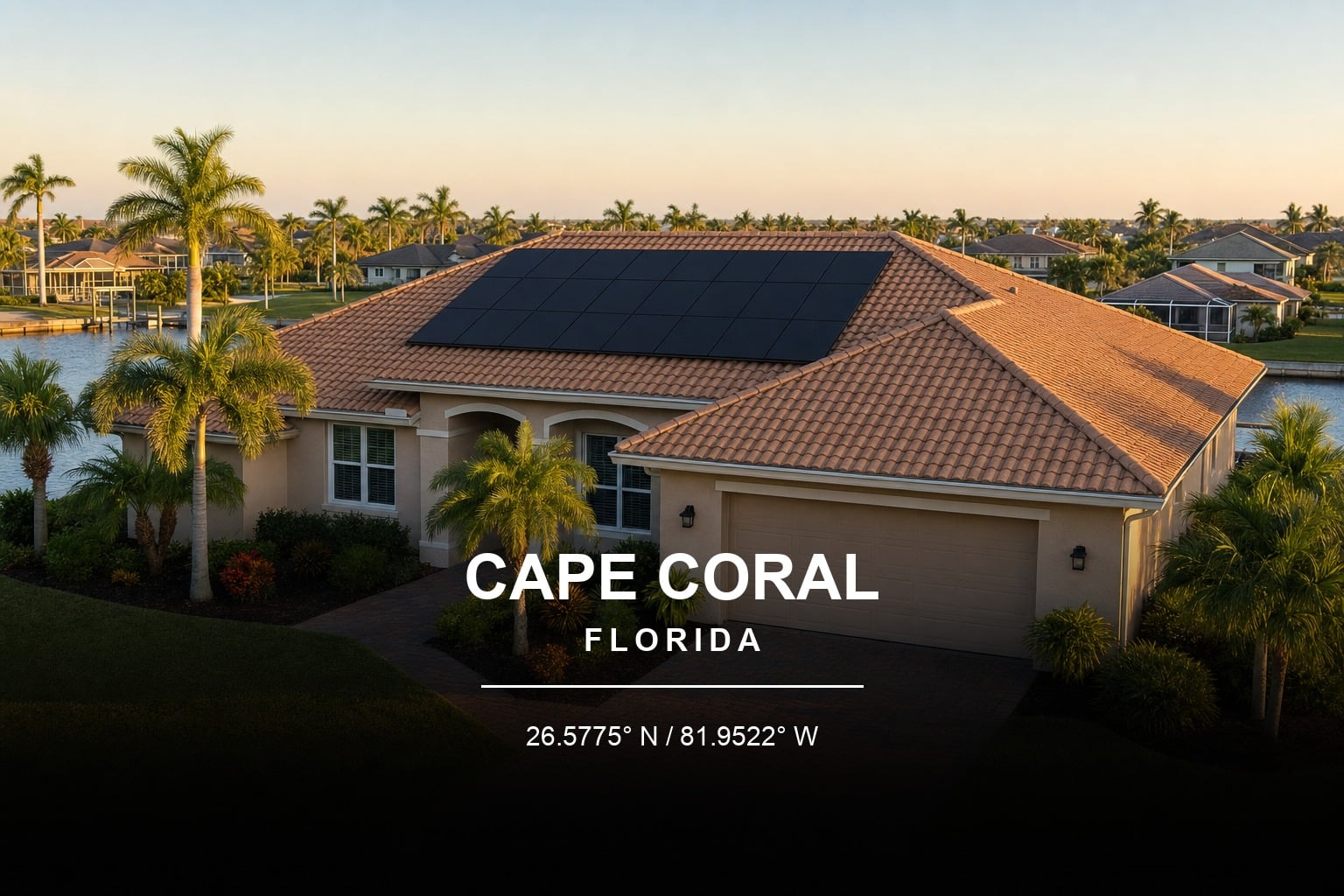
Lee County Electric Cooperative serves Cape Coral, Fort Myers, Bonita Springs, Marco Island, and much of Southwest Florida. LCEC is a member-owned electric cooperative — not an investor-owned utility like FPL or Duke Energy Florida — and is therefore not subject to the Florida Public Service Commission’s mandatory net metering rule that governs the state’s IOUs. LCEC offers full retail-rate net metering voluntarily, matching the same 1:1 credit structure that Florida law requires of its investor-owned utilities. For Cape Coral homeowners, this means every kilowatt-hour exported to the LCEC grid during a billing period earns a credit at LCEC’s current residential retail rate, approximately 14.5¢ per kilowatt-hour. Credits roll forward month-to-month. At the end of the 12-month period, any remaining unused credits are paid out at LCEC’s avoided cost rate — approximately 3–4¢ per kilowatt-hour — rather than the full retail credit rate. Florida utilities limit system size to no more than 115% of annual household electricity consumption; LCEC follows this same sizing guideline. Because LCEC’s net metering is offered voluntarily rather than mandated, Cape Coral homeowners should be aware that cooperative net metering terms can be modified through the cooperative’s board governance processes. Locking in interconnection under current terms establishes your right to the current program structure.
Florida is one of a small number of states that effectively prohibits third-party solar ownership for residential customers. Under Florida law, only regulated utilities can sell electricity directly to consumers — a structure that prevents the solar lease and power purchase agreement (PPA) models common in California, Massachusetts, New York, and many other states. In Florida, including Cape Coral, a homeowner who wants rooftop solar has two ownership options: a cash purchase, which delivers the best long-term ROI by avoiding interest charges and capturing all incentives; or a solar loan, which finances the system while the homeowner retains ownership from day one and benefits from all applicable incentives. There is no lease or PPA pathway for Cape Coral residential solar in 2026.
The practical implication of this restriction is significant compared to states like California or Massachusetts where leases and PPAs are common. In states with lease/PPA availability, homeowners who cannot benefit from tax credits (because they have no tax liability) can still access solar savings through lease arrangements where the installer owns the system and claims the commercial ITC. In Florida, that pathway is closed. All Cape Coral solar homeowners are system owners — which also means all applicable savings, credits, and net metering income belong to the homeowner rather than a third party.
Southwest Florida solar installations run approximately $2.60–$3.10 per watt in 2026. Cape Coral’s competitive Lee County installer market — with several Southwest Florida contractors serving the area — typically produces pricing within this range. A typical Cape Coral single-family system of 9kW–13kW costs approximately $23,400–$40,300 before incentives, reflecting the larger system sizes that high-consumption Florida homes with year-round AC require. Florida’s 6% sales tax exemption on solar equipment saves approximately $1,400–$2,400. The 100% property tax exemption (Florida Statute § 193.624) prevents any increase in annual Lee County property taxes from the added solar value. No federal residential ITC applies to cash or loan purchases in 2026. At LCEC’s approximately 14.5¢ per kilowatt-hour rate, cash-purchase payback for Cape Coral systems runs approximately 10–13 years — somewhat slower than Fort Lauderdale FPL customers who benefit from South Florida’s higher irradiance and FPL’s slightly higher rates. The 25-year savings range of $25,000–$40,000 reflects LCEC’s moderate rate level and Southwest Florida’s strong sun resource.


