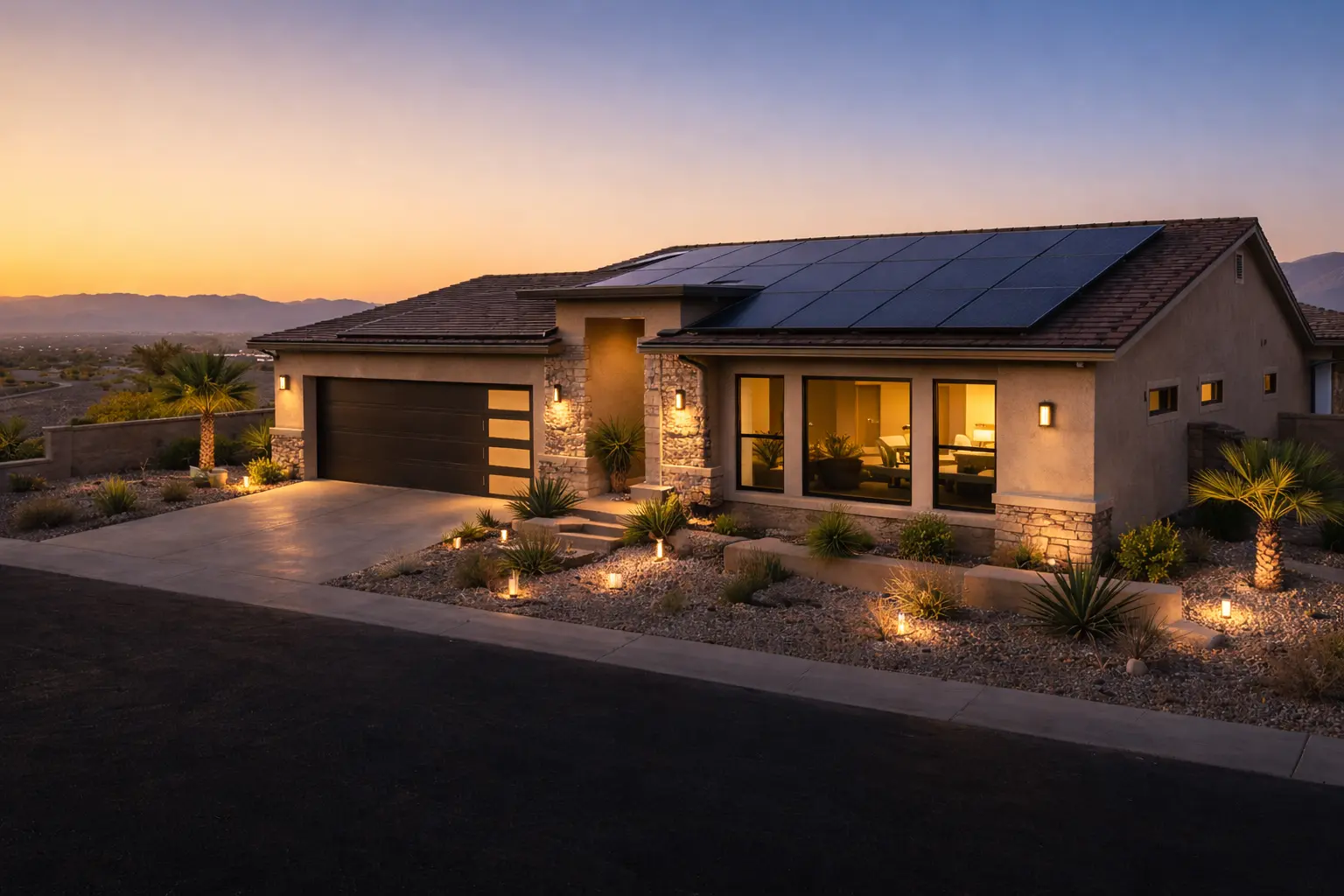
Solar Panels in Santa Fe, NM: America's Highest Capital City, Exceptional Solar Resource, and the Flat-Roof Question

Santa Fe sits at 7,199 feet above sea level — the highest state capital in the United States, nearly 2,000 feet above Albuquerque. That elevation is not a trivia footnote for solar homeowners; it means thinner atmosphere, stronger solar irradiance reaching rooftop panels, and average fixed-mount peak sun hours of 6.4 per day year-round, climbing to over 8 with tracking systems. PNM serves the Santa Fe market with full retail net metering and indefinitely rolling credits. New Mexico’s 10% Solar Market Development Tax Credit — up to $6,000 — is the primary incentive in 2026 following the expiration of the federal residential credit on December 31, 2025. Santa Fe’s distinct character introduces one consideration no other New Mexico city shares: a significant portion of the city’s housing stock falls under historic district oversight, and the traditional flat-roof adobe and Pueblo Revival architecture that defines Santa Fe’s skyline shapes how solar is designed and installed here.

Santa Fe's Solar Physics: Why Being the Highest Capital in America Matters for Your Panels

At 7,199 feet, Santa Fe has the thinnest urban atmosphere of any state capital in the country. Each additional thousand feet of elevation reduces the atmosphere’s thickness, meaning less scattering and absorption of sunlight before it reaches a panel surface. The practical result is higher solar irradiance per square meter than nearly any other major city — including Albuquerque, Phoenix, or Denver.

Fixed-mount residential panels in Santa Fe average 6.4 peak sun hours daily across the full year. The production window runs long: April through September delivers 7 or more peak sun hours on most days, while even the shortest winter months average around 5. The monsoon season in July and August — brief afternoon storms typical of the high desert — temporarily reduces afternoon production but leaves mornings largely unaffected and doesn’t substantially change full-year output totals.

For homeowners, the altitude advantage translates directly into smaller systems achieving the same annual production targets. Santa Fe’s average monthly consumption (around 888 kWh based on EnergySage data) is lower than Albuquerque’s, and the high irradiance means a well-designed 7–9kW system typically offsets 100% of annual consumption for most homes. Energy-efficient homes — common among Santa Fe’s historically-minded, adobe-construction housing stock, which has natural thermal mass that moderates heating and cooling loads — may need systems as small as 3–5kW to achieve full offset. The city’s cooler summer temperatures compared to Albuquerque also reduce air conditioning loads and the consumption peaks that drive system sizing elsewhere in the Southwest.

Historic Districts, Adobe Roofs, and the Installation Considerations Unique to Santa Fe

Santa Fe’s historic building stock creates installation questions that don’t exist in most American cities. A significant portion of downtown Santa Fe and the Eastside — including much of Canyon Road and the area around the Plaza — falls within the city’s historic districts, where the Historic Districts Review Board oversees exterior modifications. The city’s ordinance prohibits visible additions to structures in its purview that would impact original architectural character.

For solar purposes, this means panels visible from the public right of way may face additional review or design constraints. The good news is that Santa Fe’s predominant architectural form — flat-roof adobe and Pueblo Revival construction with parapet walls — actually enables concealment that sloped-roof homes can’t match. A parapet high enough to obscure panels from street level satisfies the visibility concern while still capturing full rooftop solar production. The San Miguel Chapel solar installation, completed in 2023, demonstrated this approach: panels installed flat on a parapet-surrounded roof, invisible from the street, fully functional. For Santa Fe homeowners in or near historic districts, the design conversation with an installer should begin with parapet height and visibility sightlines, not just roof orientation.

Outside historic districts — which includes most residential neighborhoods in the Southside, along Cerrillos Road, in the DeVargas area, and in surrounding unincorporated Santa Fe County — standard installation approaches apply with no heightened review. Santa Fe’s single-family neighborhoods outside the historic core look much like other New Mexico communities, with pitched and flat roofs, minimal shading, and straightforward permitting through the city’s Development Services Department.

New Mexico state law limits how far HOAs can restrict solar installations — they may impose reasonable aesthetic guidelines (panel flush-mounting, equipment color matching) but cannot effectively prohibit solar or reduce system efficiency to the point of making it uneconomical. Even in communities with HOA oversight, most Santa Fe homeowners have a viable path to installation. Ground-mounted systems are an option on properties with sufficient lot size, particularly in the broader Santa Fe County area outside the city core.

Incentives, Costs, and What Solar Economics Look Like in Santa Fe in 2026

Santa Fe’s solar cost data from the EnergySage Marketplace shows an average of $2.94 per watt as of early 2026 — slightly above Albuquerque’s $2.78 per watt, reflecting the smaller installer market and somewhat higher labor costs in a metro of around 85,000 people. The average Santa Fe system size is 8.28kW, costing approximately $24,400 before incentives. Prices range from about $20,700 to $28,000 depending on system size, equipment choices, and roof conditions.

New Mexico’s Solar Market Development Tax Credit (SMDTC) provides 10% of qualified installation costs, capped at $6,000. On a $24,400 system, this delivers a $2,440 state income tax credit, reducing net cost to approximately $22,000. The credit requires pre-certification from the New Mexico Energy, Minerals, and Natural Resources Department (EMNRD) before claiming, and carries forward up to 10 years if it exceeds annual state tax liability. New Mexico’s solar property tax exemption prevents the added value of panels from increasing assessed property value or annual tax bills — a particularly meaningful protection in Santa Fe, where home values are among the highest in New Mexico and property tax exposure is correspondingly larger.

The federal 30% residential solar tax credit expired December 31, 2025, under the One Big Beautiful Bill. For Santa Fe homeowners purchasing systems with cash or loans in 2026, the incentive stack is state-only. Third-party-owned systems — leases and PPAs — may still access the commercial ITC (Section 48/48E, 30%) if construction begins before the federal phase-out threshold, and PPA providers in New Mexico typically factor this benefit into contract rates.

EnergySage estimates Santa Fe homeowners save approximately $18,467 over 25 years on a purchased, average-sized system. PNM’s rate trajectory adds tailwind to that estimate: the utility has sought two-phase rate increases implemented in 2025 and 2026 as it funds grid modernization following the 2022 closure of the San Juan Generating Station. Those rate increases improve the annual savings from solar going forward. The Santa Fe County Sustainability Office offers free, impartial solar consultations for county residents considering installation — a genuinely useful starting point before engaging installers.

Frequently Asked Questions

It depends on your specific property and neighborhood. Santa Fe’s historic district ordinance restricts visible exterior modifications to buildings within the district that would affect original architectural character. For solar, this primarily means panels cannot be conspicuously visible from the public right of way. However, Santa Fe’s flat-roof adobe and Pueblo Revival architecture works in homeowners’ favor: parapet walls on flat roofs can conceal panels from street view while still allowing full production. Installers experienced with Santa Fe’s historic requirements know how to design systems that meet the sightline requirements. If your property is outside the historic district — which includes most residential neighborhoods beyond the downtown core and Eastside — standard permitting applies with no heightened review. The city’s Development Services Department can confirm whether your specific address falls within a historic overlay zone.
Santa Fe at 7,199 feet has noticeably higher solar irradiance reaching rooftop panels than cities at lower elevations, because the thinner atmosphere scatters and absorbs less sunlight. Fixed-mount panels in Santa Fe average 6.4 peak sun hours daily year-round — comparable to Albuquerque but with higher irradiance intensity per hour due to the extra elevation. In practical terms, a Santa Fe solar system produces more kilowatt-hours per watt of installed capacity than the same system in Denver (5,280 ft), Atlanta, or most eastern US cities. This means smaller, less expensive systems can offset the same percentage of a household’s consumption. Santa Fe’s cooler average summer temperatures also improve panel efficiency compared to lower desert cities — panels lose output in extreme heat, and Santa Fe’s high desert summer temperatures are more moderate than Phoenix or Las Vegas.
Santa Fe solar installations average approximately $2.94 per watt as of early 2026, slightly above the statewide average of $2.78 due to the smaller local installer market. A typical 8.28kW system — sized to offset annual consumption for most Santa Fe homes — costs about $24,400 before incentives. After New Mexico’s 10% Solar Market Development Tax Credit (up to $6,000), net cost is approximately $22,000. The federal 30% residential credit expired December 31, 2025 and is not available for new installations. EnergySage projects total 25-year savings of approximately $18,467 on a purchased system, based on current PNM rates and assuming modest annual rate increases. Energy-efficient homes common in Santa Fe — adobe construction has inherent thermal mass that reduces heating and cooling loads — often need smaller systems (4–6kW) that cost $12,000–$18,000 before incentives, improving the payback picture. Santa Fe County’s free solar consultation service can help homeowners get a realistic sizing estimate before requesting installer quotes.
Santa Fe’s predominant flat-roof adobe construction creates installation requirements that differ from pitched-roof homes. Flat roofs require ballasted mounting systems (weighted frames that sit on the roof surface without penetrations) or low-profile tilt mounts rather than the standard rafter-attached racking used on sloped roofs. The structural engineer or architect review requirement that applies to ballasted systems is standard practice — installers in the Santa Fe market are familiar with it. TPO and foam roofing membranes common on Santa Fe flat roofs require compatible attachment hardware. The advantage of flat roofs for solar is flexibility: panels can be oriented due south at any tilt angle the designer chooses, rather than being constrained by roof pitch. A competent Santa Fe installer will optimize tilt for maximum annual production — typically 15–25 degrees in this latitude — while keeping the system below parapet height if the property has historic visibility requirements.
Santa Fe County offers free, impartial solar consultations for residents considering installation. The program is run by the County Sustainability Office and is designed to give homeowners an objective assessment of their solar potential before they engage with installers. Consultants can help residents calculate system sizing based on 12 months of PNM usage history, understand available incentives including the state tax credit and net metering, review financing options including credit union solar loan programs through institutions like Nusenda Credit Union and U.S. Eagle, and get referrals to a list of vetted local solar contractors. The consultation is not affiliated with any installer or equipment vendor, making it a useful starting point for homeowners who want an unbiased orientation before entering the sales process. Contact Santa Fe County Community Development / Sustainability for current availability and scheduling.

Not sure how to compare solar companies?

Before contacting installers, read our guide on how to evaluate proposals, warranties, and long-term support.