
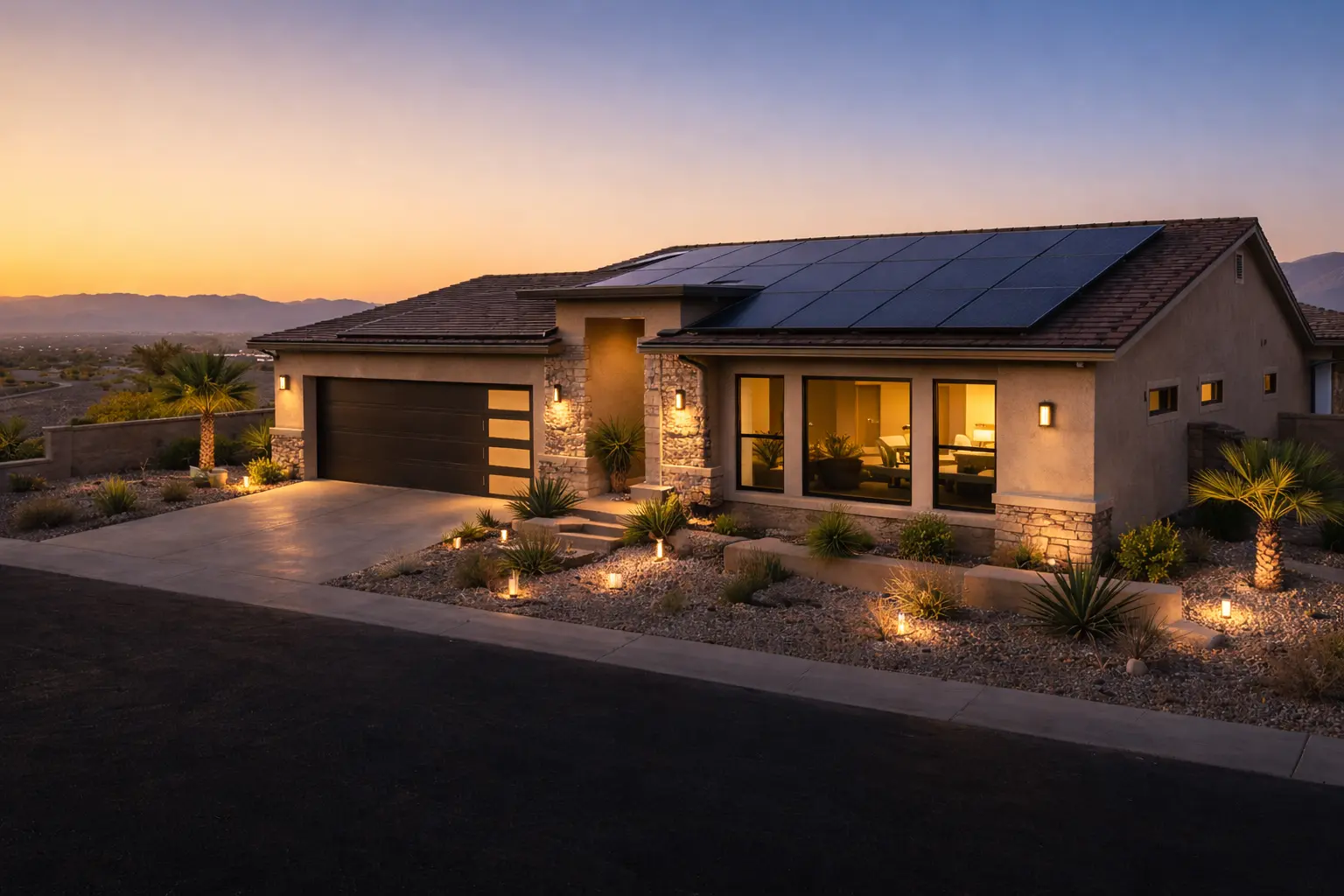
Albuquerque’s solar production advantage is physical, not financial. At over a mile of elevation, the atmosphere is thinner, meaning less particulate matter and water vapor attenuates sunlight before it reaches a rooftop panel. Clear, low-humidity desert air compounds the effect. The result: a typical 8kW system in Albuquerque produces roughly 12,500–14,000 kWh annually, compared to 9,500–11,000 kWh for the same system in Atlanta or Denver. More production per watt means a smaller, less expensive system can offset the same percentage of a home’s electricity consumption.
The practical implication for sizing: PNM’s net metering policy credits excess generation at the full retail rate up to 100% of the customer’s annual utility demand. Generation beyond that threshold is credited at PNM’s avoided-cost rate, which is substantially lower — roughly 2–5¢ per kilowatt-hour compared to the retail rate of around 16¢. Oversizing to export large amounts of power works against you mathematically. The standard sizing approach — matching system output to annual consumption — is more important in New Mexico than in states with more generous over-production compensation. Because Albuquerque systems produce so efficiently, homeowners often need fewer panels than they’d expect, which keeps system cost down.
Summer is a uniquely important production season here. Albuquerque’s peak sun hours run from April through September, with July and August delivering the most solar irradiance despite afternoon monsoon activity. The monsoon season — roughly mid-July through mid-September — brings brief but intense afternoon storms that temporarily reduce production, but mornings remain clear and the overall summer production window is still one of the most productive in the country. Winter production remains meaningful: even November through January average around 4 peak sun hours daily, so credits banked in summer are rarely needed to cover an entire winter shortfall.
PNM is New Mexico’s largest utility and Albuquerque’s primary electricity provider. As of early 2026, PNM’s residential rate in the Albuquerque market runs approximately 16¢ per kilowatt-hour — above the New Mexico state average of around 13.8¢ and roughly at the national average, though PNM has filed successive rate cases as it funds grid modernization and retires legacy coal generation. Albuquerque residents who shopped solar on the EnergySage Marketplace averaged around $150 per month on electricity, roughly 942 kWh monthly.
PNM’s net metering program for systems up to 10kW (the residential standard) works as follows: generation applied to your home’s real-time consumption reduces your bill at the retail rate. Net excess generation beyond what you consumed in a billing period is credited as a kilowatt-hour credit that rolls forward month to month indefinitely — PNM credits never expire. If your system produces more than you consume over the full year, the annual surplus settles at PNM’s avoided-cost rate rather than retail. This makes it important to size a PNM system to produce approximately what the household consumes annually, neither significantly under nor over. A competent installer will run a consumption analysis against 12 months of PNM bills to determine the right system size before recommending a design.
PNM has been on an upward rate trajectory as it transitions its generation portfolio. New Mexico’s Energy Transition Act (ETA) requires investor-owned utilities to reach 80% renewables by 2040 and 100% carbon-free by 2045. PNM has been retiring coal assets — the San Juan Generating Station closed in 2022 — and adding wind and solar, but the capital cost of that transition has pushed rates upward. Rate cases filed in recent years have proceeded before the New Mexico Public Regulation Commission, and additional increases are likely as infrastructure investment continues. Locking in solar production now effectively fixes a portion of your energy cost ahead of those increases.
New Mexico’s Solar Market Development Tax Credit (SMDTC) provides a state income tax credit equal to 10% of qualified installation costs, up to a maximum of $6,000. For a typical Albuquerque system running $22,000–$27,000 before incentives, the 10% credit delivers $2,200–$2,700 in direct tax liability reduction applied to the installation year’s New Mexico state tax return. The credit requires certification from the New Mexico Energy, Minerals, and Natural Resources Department (EMNRD) before claiming. If the credit exceeds tax liability in the installation year, it can be carried forward for up to ten years — useful for homeowners in years with lower income. The credit applies to residential, commercial, and agricultural installations and has remained active and funded.
The federal 30% residential solar tax credit (ITC/25D) expired December 31, 2025, under the One Big Beautiful Bill signed in July 2025. This is the most significant change to the Albuquerque solar market in recent years. Before expiration, a $25,000 system yielded a $7,500 federal credit and a $2,500 state credit — $10,000 total in credits against a $15,000 net cost. In 2026, only the $2,500 state credit remains for a cash-purchase installation, with net cost rising to approximately $22,500. Payback periods have lengthened accordingly.
New Mexico also provides a solar property tax exemption that prevents the added value of a solar installation from increasing a home’s assessed property value — and thus its annual property tax bill. The exemption was strengthened in 2024 legislation. A solar system that adds $20,000–$25,000 to market value would otherwise increase annual property taxes by several hundred dollars; the exemption eliminates that cost entirely and continues to apply upon sale of the property.
For third-party-owned systems — solar leases and PPAs — the commercial ITC (Section 48/48E, 30%) may still apply if construction begins before the federal phase-out threshold. PPA providers operating in New Mexico factor this credit into contract rates, which is why some PPA offers in Albuquerque remain competitive in 2026 despite the residential credit expiration.
EnergySage data as of early 2026 puts the average Albuquerque payback at roughly 9.7 years on a purchased system after the state credit, before accounting for potential PNM rate increases. Given Albuquerque systems produce for 25–30 years, the return on investment after payback is still substantial — particularly if PNM rates continue climbing during that window.
Est. 2009
Est. 2006