Solar Panels in New York City: The Nation's Richest Incentive Stack, 31¢ Rates, and the Roof Access Question

New York City has some of the highest electricity rates in the United States — Con Edison customers pay approximately 31¢ per kilowatt-hour as of early 2026, roughly 65% above the national average. That rate, combined with a stacking of federal, state, and city-specific incentives found nowhere else in the country, makes New York City one of the most financially compelling solar markets in America for homeowners who can actually access a rooftop. The critical qualifier: most New York City residents cannot. Manhattan’s co-op apartments, high-rise condominiums, and multi-family rental buildings make up the vast majority of the housing stock, and residents in those buildings typically don’t control the roof. For the homeowners in Brooklyn, Queens, the Bronx, and Staten Island with detached or semi-detached houses, solar economics are exceptional. For everyone else, community solar is the primary access path. This guide covers both populations, and explains why going solar in 2026 — before available incentives decline further — is particularly time-sensitive in New York City.

NYC's Solar Incentive Stack: Four Programs That Don't Exist Anywhere Else Together

New York City homeowners with eligible rooftops have access to an incentive combination that is unique in the country. Even without the federal residential tax credit — which expired December 31, 2025 — the remaining stack is substantial.

Con Edison net metering credits excess solar production at the full retail rate, currently around 31¢ per kilowatt-hour. Every kilowatt-hour your system exports during the day is credited at that full retail value, rolling forward month to month indefinitely. This 1-to-1 exchange makes net metering more financially valuable in NYC than almost anywhere in the country — the same kilowatt-hour exported in New Jersey earns ~18¢; in New York City it earns ~31¢. When you go solar today, Con Edison locks you into this net metering arrangement for 20 full years. A small Customer Benefit Contribution (CBC) charge applies to all solar customers: approximately $1.84 per kW per month, so about $13/month for a 7kW system. This is the only unavoidable ongoing cost for grid-tied NYC solar customers.

The NY-Sun Megawatt Block rebate, administered by NYSERDA, provides an upfront cash discount paid directly to your installer — reducing the price you see on the contract. As of early 2026, the Con Edison territory rate is in the $0.20–$0.40 per watt range, depending on which block is current. For a 7kW system, this translates to $1,400–$2,800 off the top. The program runs on declining blocks — as installations accumulate, rebate rates step down — so earlier adoption captures higher rebate levels. Block availability should be confirmed with a NYSERDA-approved contractor before signing.

New York State’s solar tax credit provides 25% of qualified installation costs (after the MW Block rebate is subtracted), up to a maximum of $5,000. This is a direct state income tax credit — dollar-for-dollar reduction in NY state tax liability — not a deduction. On a $25,000 system after a $2,000 MW Block rebate, the 25% credit calculates on $23,000 and delivers $5,000 (the maximum). Credits that exceed state tax liability in the installation year carry forward for up to five years.

The NYC Solar Property Tax Abatement (PTA) is exclusive to New York City and available through January 1, 2035. It provides a credit equal to 7.5% of the installed system cost per year for four consecutive years — totaling 30% of post-rebate installation cost — applied directly against annual property tax bills. It does not reduce the system’s base value for calculating the state tax credit. The abatement is capped at $62,500 per year (or actual property tax liability, whichever is less) and $250,000 total over the four-year period. Unlike the state tax credit, which processes through a tax return, the PTA requires a licensed New York State architect or professional engineer to file paperwork with the NYC Department of Buildings. Most experienced NYC installers handle this as part of their service, but confirm this explicitly during contract negotiation. A 15-year property tax exemption under NYS Real Property Tax Law §487 additionally prevents the added value of solar from increasing assessed property taxes — separate from and additive to the abatement.

Who Can Actually Install Solar in NYC: The Housing Stock Reality and the New Zoning Rules

The roof access question is the most important practical issue for NYC solar. The city’s housing stock divides sharply into buildings where rooftop solar is viable and buildings where it is not.

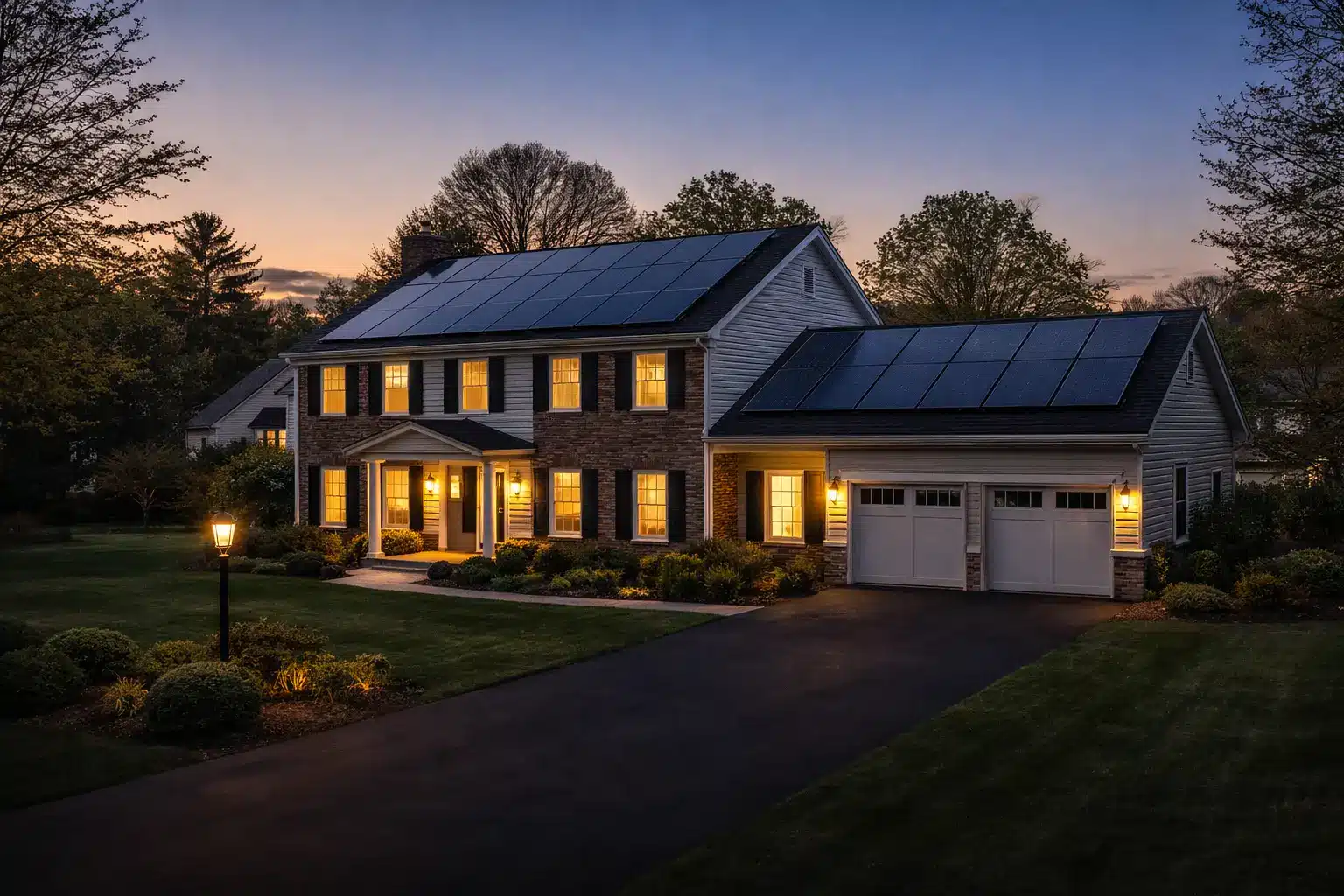
Homeowners with eligible buildings — primarily detached and semi-detached single-family and two-family homes, most common in Brooklyn (Bay Ridge, Flatbush, Marine Park, Dyker Heights), Queens (Howard Beach, Bayside, Whitestone, Jamaica Estates), Staten Island broadly, and parts of the Bronx — can install rooftop solar using standard residential processes. These homes with pitched or flat roofs, clear of significant shading, are straightforward candidates. FDNY fire code requirements mandate clear rooftop access paths — generally 6 feet wide on larger flat roofs, 4 feet on smaller ones — which reduces available panel area but rarely eliminates viability entirely.

Manhattan co-op and condominium buildings represent the largest category of ineligible properties. Individual unit owners do not control the roof; the building’s board or HOA does. Even in co-ops where the board supports solar, the building’s roof is typically a shared asset covering hundreds of units, and a single-unit solar installation is not viable. Building-scale commercial installations on larger NYC multifamily buildings are possible under commercial programs, but this is not homeowner solar.

A significant zoning reform took effect in December 2024 as part of the city’s “City of Yes” initiative, removing many of the restrictive setback and visibility rules that previously prevented flat-roof solar installations in about half of Brooklyn and Queens. The new rules also allow elevated solar canopy structures — panels mounted 9+ feet above the roof surface — over flat roofs, driveways, and backyards. This is significant: canopies satisfy FDNY fire access requirements more easily than ground-level panel arrays while also opening up rooftop spaces previously blocked by parapet heights, mechanical equipment, or building setback rules. For homeowners whose pre-2024 consultations found their roof ineligible, it is worth requesting a new evaluation under the updated zoning.

FDNY prohibits indoor residential battery storage for lithium-ion systems. This means NYC solar customers cannot add home battery backup — a meaningful limitation compared to markets where battery plus solar is the standard package. Net metering serves as the functional substitute: daytime excess production banks as credits, offsetting nighttime grid draw. During a Con Edison outage, grid-tied solar systems (without battery) automatically shut off for utility worker safety. The prohibition on indoor residential batteries is a standing policy position from FDNY based on fire safety concerns in dense residential buildings. Outdoor rooftop storage installations are permitted under separate rules but are complex and uncommon in residential applications.

NYC Solar Costs, the Con Edison Rate Trajectory, and What the 2026 Economics Look Like

New York State solar installations average approximately $2.77 per watt as of early 2026, based on EnergySage Marketplace data. A typical New York City rooftop system runs 6–9kW for most detached homes in Brooklyn, Queens, and Staten Island — not the statewide average of 12.37kW, which reflects larger upstate homes. A 7kW system at the NYC market rate runs approximately $19,000–$21,000 before incentives.

Applying the incentive stack to a $20,000, 7kW system: MW Block rebate ($0.30/W average) subtracts $2,100, bringing the base to $17,900. The NY State 25% tax credit on $17,900 is $4,475. The NYC Property Tax Abatement on $17,900 is $5,370 spread over four years (~$1,340/year). Net cost after all incentives (excluding PTA timing): approximately $11,000–$13,500 depending on exact MW Block rate and tax credit utilization. The 25-year savings projection from EnergySage for NYC is approximately $69,000, with a payback period of approximately 7.7 years.

Con Edison’s rate trajectory adds urgency to the timing case. The utility sought an 11.4% electric delivery rate increase initially for 2026, which was negotiated down to 3.5% after widespread public opposition, with further incremental increases scheduled for 2027 and 2028 under a multi-year rate settlement. Rates have been rising steadily as Con Edison funds grid infrastructure upgrades, extreme weather resilience investments, and clean energy integration costs. At 31¢/kWh today, the city already pays among the highest residential electricity rates nationally. Each rate increase improves the annual savings from a solar installation already in place.

Con Edison also underwent a Local Laws 92/94 mandate for new construction and major roof renovations: since 2019, any building replacing or constructing a roof must install solar PV or a green roof system. Systems must generate at least 4kW to qualify. For homeowners in the process of re-roofing, this creates a mandate that aligns with the financial case: bundling the solar installation with the roof replacement avoids duplication of labor costs and creates a single-contractor project.

Frequently Asked Questions

Con Edison’s net metering program credits excess solar production at the full retail electricity rate — currently around 31¢ per kilowatt-hour — for every kilowatt-hour your system exports to the grid beyond what your home uses in real time. Credits roll forward month to month indefinitely in a “solar bank.” When you need grid power at night or on cloudy days, Con Edison draws down your banked credits before billing you for any remaining grid consumption. The 20-year lock-in means that when you interconnect today, Con Ed commits to the current net metering terms — full retail credit rate, rolling forward credits — for a full 20 years from your interconnection date. If New York later changes its net metering policy (as California did in 2023 with its NEM 3.0 shift to a dramatically lower export rate), your locked-in agreement is grandfathered. This lock-in is a significant financial protection given the ongoing policy evolution nationally. One small charge applies: the Customer Benefit Contribution (CBC), approximately $1.84/kW/month — about $13/month for a 7kW system — cannot be offset by net metering and will appear on every bill.
The NYC Solar Property Tax Abatement (PTA) is a city-exclusive incentive that reduces annual property tax bills by 7.5% of the installed solar system cost per year for four consecutive years, totaling a 30% abatement. It applies to the post-MW-Block-rebate system cost. For a $17,900 post-rebate system, the annual abatement is $1,340/year for four years, or $5,360 total — applied directly as a credit on your NYC property tax bill. The abatement is capped at $62,500/year or your actual property tax liability (whichever is less) and $250,000 over the four-year term. Systems placed in service between January 1, 2024 and January 1, 2035 are eligible. To apply: you or your installer must hire a New York State Registered Architect or Professional Engineer to file the PTA application with the NYC Department of Buildings. Most experienced NYC solar installers handle this as a standard part of their service — verify this explicitly before signing a contract, as the PTA application adds cost if managed separately. The abatement does not reduce the base cost used to calculate the NY State 25% tax credit.
New York solar quotes on the EnergySage Marketplace average approximately $2.77 per watt before incentives as of early 2026. A 7kW system typical for a Brooklyn or Queens detached home costs approximately $19,000–$21,000 before incentives. After the incentive stack — MW Block rebate ($1,400–$2,800), NY State 25% tax credit (up to $5,000), and NYC Property Tax Abatement (30% of post-rebate cost over four years) — net effective cost after all incentives is approximately $11,000–$13,500 depending on exact rebate rates and tax credit utilization. EnergySage data puts the NYC payback period at approximately 7.7 years. The average Con Edison customer spends about $350/month on electricity; a well-sized system offsets most of that bill (the ~$13/month CBC charge and basic service charge remain unavoidable). Projected 25-year savings are approximately $69,000 after accounting for the upfront system cost.
Probably not through rooftop installation. In Manhattan co-ops and condominiums, individual unit owners do not own or control the roof, which is a shared building asset managed by the co-op board or condo HOA. A single-unit solar installation is not viable on a shared roof. Even if a building’s board is supportive of solar, building-scale commercial solar projects on large multifamily buildings require commercial programs and engineering approaches that go well beyond residential solar. If you’re in a Manhattan co-op, condo, or rental apartment — or any NYC multi-unit building where you don’t control the roof — community solar through Con Edison’s territory is the most accessible option. Community solar subscribers receive bill credits at a discounted rate without any installation required. NYSERDA maintains a community solar project directory searchable by utility territory. Subscribers should review contract terms carefully, particularly regarding minimum subscription periods and what happens if you move.
The FDNY prohibits indoor installation of lithium-ion battery storage systems in residential buildings. This applies to products like the Tesla Powerwall and equivalent home battery systems that are widely installed in other markets. FDNY’s position is based on fire safety concerns in the city’s dense residential building stock — a battery fire in a rowhouse attached to dozens of neighboring units carries different risk than the same failure in an isolated suburban home. Outdoor rooftop battery installations are permitted under separate FDNY rules but are practically complex and uncommon in residential applications. For Con Edison solar customers, net metering serves as the functional substitute: daytime surplus production banks as credits in your Con Ed account, available to offset nighttime grid consumption at the same retail rate. During grid outages, grid-tied solar without battery automatically shuts off to protect utility workers — so backup power during blackouts is not available without storage. The industry is actively advocating for revised FDNY battery policies; the situation is worth monitoring as technology and code interpretations evolve.

Not sure how to compare solar companies?

Before contacting installers, read our guide on how to evaluate proposals, warranties, and long-term support.
Learn More
Learn More
Learn More
Learn More
Learn More
Learn More
Learn More
Learn More
Learn More
Learn More
Learn More
Learn More
Learn More
Learn More
Learn More
Learn More
Learn More
Learn More