
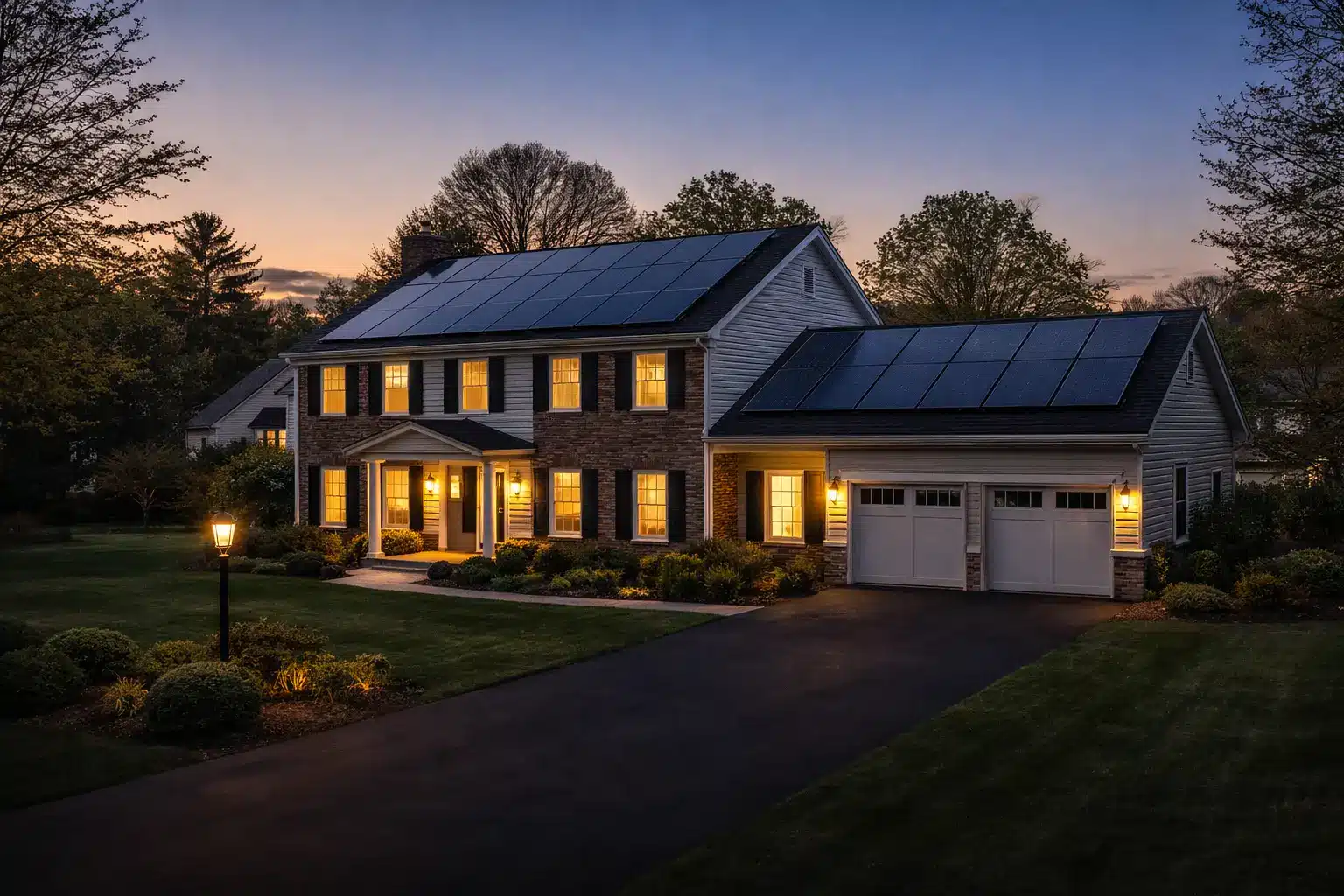
Buffalo averages approximately 4.1 peak sun hours daily on a properly tilted fixed-mount system — a legitimate constraint compared to Albuquerque’s 6.4 or Phoenix’s 7+. But that number does not tell the full production story, and the cloud narrative is frequently overstated.
Modern monocrystalline panels produce meaningful output under diffuse light — the scattered irradiance on an overcast day. A dense cloud cover reduces production to roughly 10–25% of peak output, but a partly cloudy day with intermittent sun can still deliver 50–70%. The practical result is that Buffalo systems produce real kilowatt-hours year-round, just with an obvious seasonal pattern: summer months from May through August are the production peak, when Buffalo receives clear days with long daylight hours and solar angles that push production well above daily averages. Winter months — November through February — deliver reduced output from shorter days, lower sun angles, and more persistent cloud cover.
The seasonal swing is large, and this is the central production planning consideration in Buffalo. A well-designed system is sized to the annual total consumption, not the monthly winter average. Summer surplus production banks as net metering credits with National Grid, which then offset the reduced winter production when the system draws from grid power. The net metering rolling credit bank is what makes the math work across the full year.
Snow is a legitimate practical consideration. Panels mostly self-clean as snow melts, particularly on south-facing pitches, but heavy accumulations can temporarily reduce output to near zero. Most Buffalo solar owners manage this by allowing natural melt rather than manual removal (accessing icy rooftops is hazardous), accepting that several winter days of minimal production are already accounted for in the annual sizing model. The edge-of-cloud effect — when cloud margins briefly concentrate irradiance on panels — actually provides brief production spikes on partially cloudy days that partially offset the cloud reduction penalty.
Buffalo homeowners fall under National Grid’s service territory, which means they access the Upstate NY-Sun Megawatt Block rebate rather than Con Edison’s higher-rate block. The distinction matters: the Upstate rate is $0.20 per watt versus Con Edison’s $0.40/W. For a 7kW system, that means a $1,400 upfront rebate applied directly to the installer’s contract price rather than $2,800 in the NYC territory. The rebate is still meaningful, and the program operates on the same declining-block structure — as installed capacity accumulates in the Upstate block, the rate steps down. Current status should be confirmed with a NYSERDA-approved installer before signing.
The NY State 25% solar tax credit applies statewide with no territory variation: 25% of qualified installation costs (after the MW Block rebate is subtracted) up to a $5,000 maximum. For most Buffalo systems — which average around 5kW and cost approximately $13,000–$15,000 before incentives — the 25% credit on the post-rebate cost delivers $2,900–$3,500 in state income tax credit. Credits that exceed annual state tax liability carry forward up to five years.
New York’s 4% sales tax exemption on solar equipment and installation reduces the pre-incentive system cost directly. The 15-year property tax exemption under NYS Real Property Tax Law §487 prevents solar from increasing assessed home value — and therefore annual property tax bills — for 15 years from installation. In Buffalo’s housing market, where solar adds measurable resale value (Zillow research estimates approximately $6,000 in added value for a median-priced Buffalo home), this exemption matters. National Grid’s CBC charge for solar customers runs $1.45 per kW per month — approximately $7.25/month for a 5kW system — which remains on every bill and cannot be offset by net metering credits. This is the only unavoidable ongoing grid charge for Buffalo solar customers beyond standard basic service fees.
Buffalo homeowners, unlike their counterparts in New York City, face no FDNY battery prohibition. Home battery storage systems — Tesla Powerwall and comparable products — can be installed alongside solar panels in Buffalo residential properties. Battery pairing adds resilience against National Grid outages (which Buffalo’s weather history makes relatively common during ice storms and severe lake-effect events) and is worth evaluating at the time of solar installation.
EnergySage Marketplace data from Buffalo shows solar installations averaging approximately $2.64 per watt as of late 2025, making Buffalo one of the lower-cost solar markets in New York State. The average Buffalo system size is approximately 5kW, reflecting lower average monthly consumption (~640 kWh) compared to larger upstate homes or the statewide average. A 5kW system at $2.64/W costs approximately $13,200 before incentives.
Applying the upstate incentive stack to a $13,200 system: the MW Block rebate at $0.20/W subtracts $1,000, bringing the base to $12,200. The NY State 25% tax credit on $12,200 is $3,050. After incentives (excluding the 4% sales tax savings), net cost is approximately $9,150. EnergySage projects a payback period of approximately 7.7 years for Buffalo homeowners, with 25-year savings of approximately $69,400 after accounting for the upfront net cost.
The average Buffalo monthly electricity bill runs approximately $192 — much lower than NYC’s $350, reflecting lower consumption and National Grid’s ~17¢/kWh rate versus Con Edison’s 31¢. The financial case in Buffalo is driven less by any single bill’s size and more by the combination of modest system cost, solid state incentives, and the protection against New York State’s steadily rising electricity rates. New York electricity rates climbed roughly 25% between 2021 and 2024, from approximately 19.5¢/kWh to 24.4¢/kWh statewide, with no structural reason for that trend to reverse. A Buffalo homeowner who locks in solar production today insulates themselves from that trajectory for 25+ years.
System sizing for Buffalo should emphasize annual production-to-consumption matching rather than monthly peaks. Sizing for the winter monthly minimum would dramatically undersize the system and leave significant summer savings on the table. A competent Buffalo installer will model full-year production using local irradiance data and size for annual offset, typically in the 5–8kW range depending on home consumption, roof orientation, and available panel area.
Est. 2010
Est. 2003
Est. 2014
Est. 2009
Est. 2009
Est. 2003
Est. 2015
Est. 2012
Est. 2007
Est. 2006