
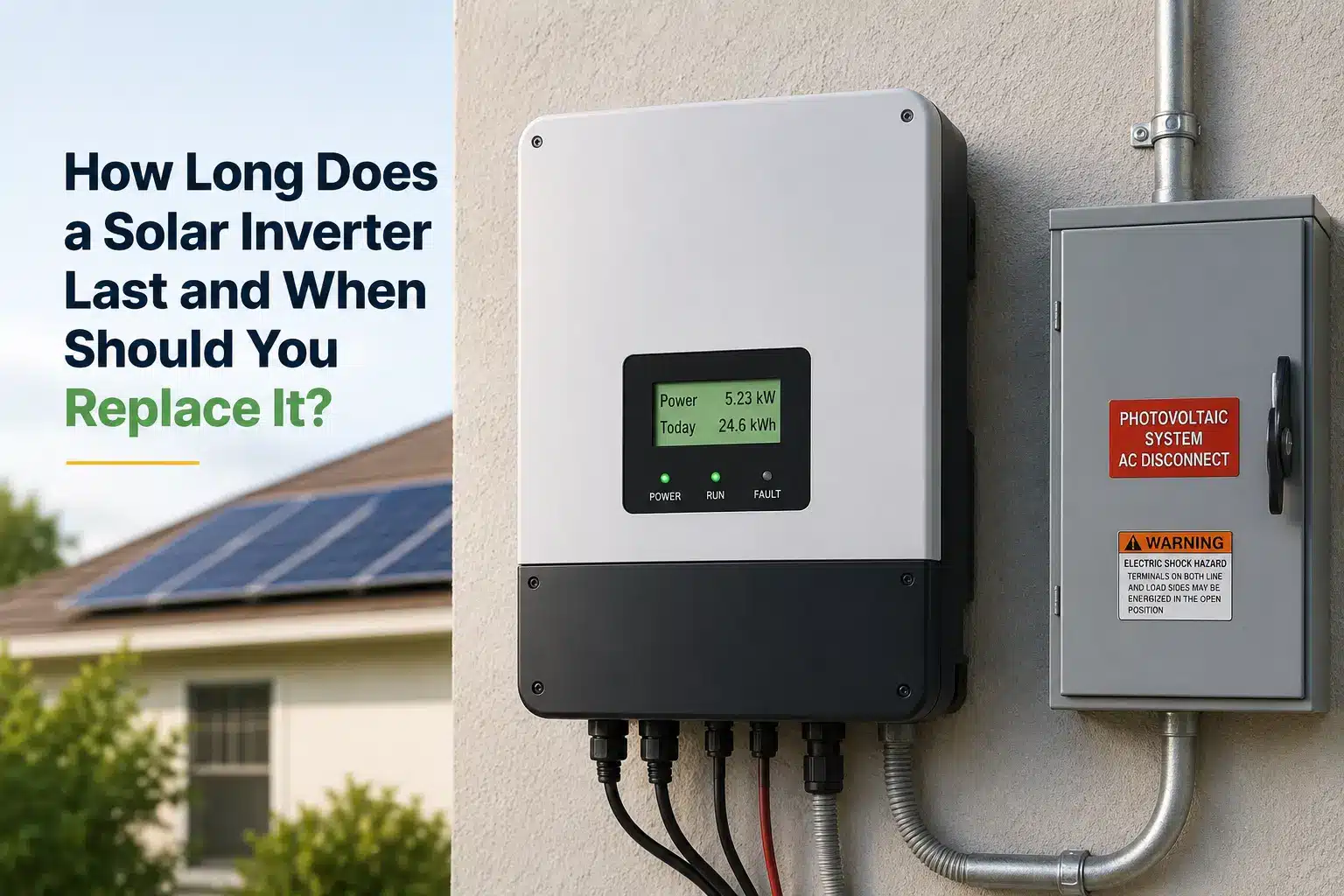
Solar inverter lifespan typically runs 10-15 years for string inverters and 20-25 years for microinverters — but environmental factors can shorten or extend that range. If your inverter is approaching the end of its warranty or showing signs of failure, replacement is an opportunity to upgrade your entire system, not just swap a component.
How Long Do Different Types of Solar Inverters Last?
The lifespan of your solar inverter depends primarily on its type and how hard it works every day.
String inverters — the large box typically mounted on an exterior wall or in your garage — last 10-15 years on average. Most manufacturers warranty them for 10-12 years, with optional extensions to 20-25 years available at install time. The components inside a string inverter (capacitors, cooling fans, circuit boards) degrade faster than solar panels because they’re actively converting DC to AC power and managing heat all day.
Microinverters — small units mounted under each solar panel on your roof — generally last 20-25 years. Enphase and APsystems typically warranty microinverters for 25 years. Because microinverters spread the conversion work across many small units instead of one central box, each unit runs cooler and experiences less thermal stress. The tradeoff is that replacement requires a technician to access your roof, which adds labor cost if one fails.
Power optimizers paired with a string inverter (the SolarEdge model) fall in between: the optimizers themselves are warrantied for 25 years, but the central inverter still has a 12-year standard warranty. When the inverter fails, the optimizers stay in place — you only replace the inverter box.
The bottom line: expect to replace a string inverter at least once during your solar system’s 25-30 year life. Microinverter systems rarely require replacement before the panels themselves age out.
What Shortens an Inverter’s Lifespan?
Inverters fail early for predictable reasons — most of them related to heat and exposure.
Direct sunlight and heat are the biggest killers. If your string inverter was installed on a south or west-facing wall in full sun, it’s cooking all afternoon. Inverters generate heat internally during conversion, and adding external heat accelerates the breakdown of capacitors and other temperature-sensitive components. Garage installs in unconditioned spaces in hot climates have the same problem. Ideal placement is a shaded north wall or conditioned indoor space.
Poor ventilation around the inverter compounds the heat issue. Inverters need airflow. If yours is boxed in, covered by landscaping, or mounted in a tight alcove, it’s running hotter than it should.
Voltage stress from the grid also matters. In areas with unstable grid voltage or frequent power events (lightning, brownouts, transformer issues), the inverter works harder to maintain synchronization. Over time this wears on internal components. This is more common in rural areas on long distribution lines.
Burned-out LCD screens are cosmetic but tell you something important: the inverter has been heat-stressed. If the screen is blank or unreadable but the system is still producing power (check your monitoring app), the inverter itself may still have years left. The screen failure is a warning sign, not a reason to replace immediately — but it does mean the unit has been running hot.
Microinverters avoid most of these issues because they’re mounted under the panels in shade and designed to handle roof-level heat. They fail less often, but when they do it’s usually from moisture intrusion or a manufacturing defect within the warranty period.
When Should You Replace Your Inverter?
Most inverter replacements happen for one of three reasons: total failure, end of warranty, or a planned system upgrade.
Total failure is obvious — the system stops producing and the inverter won’t restart. You’ll see error codes, no AC output, or a completely dark display. At that point replacement is not optional. Check your warranty first. If the inverter is still covered, the manufacturer will replace it at no cost (though you may pay labor). If it’s out of warranty, you’re buying a new unit.
End-of-warranty replacement is a judgment call. Some installers recommend replacing a string inverter proactively at year 10-12 even if it’s still working, especially if you’re planning to stay in the home long-term. The logic: you avoid an emergency replacement later, you can budget for it, and you upgrade to a more efficient model. This makes more sense if your inverter has shown signs of stress — frequent faults, reduced efficiency, or a failed display.
System upgrades are the third common trigger. If you’re adding panels, moving to a battery storage system, or replacing an outdated inverter that’s incompatible with modern monitoring, replacement becomes part of a bigger project. This is often the best time to replace an aging inverter even if it’s technically still working.
One important note: if you’re adding a battery, you may not need to replace your existing inverter at all. Hybrid inverters like the Tesla Powerwall 3 include both the battery and a built-in inverter that can manage your entire system — including existing panels. This turns an inverter replacement into a storage upgrade, which may qualify for state incentives even though the federal tax credit expired at the end of 2025. Check DSIRE for current programs in your state.
How Much Does Inverter Replacement Cost?
Replacement costs depend on inverter type, system size, and whether you’re doing a straight swap or upgrading.
String inverter replacement for a typical 5-8 kW residential system runs $1,500-$3,000 installed. That includes the inverter itself ($800-$1,800) plus 2-4 hours of labor for disconnection, mounting, wiring, and commissioning. If you’re upgrading to a larger inverter to support additional panels, add $500-$1,000. Replacing an inverter in a difficult location (tight attic space, second story exterior wall) increases labor cost.
Microinverter replacement is more expensive per unit but you rarely replace all of them. A single Enphase IQ8 microinverter costs $150-$250 plus $100-$200 labor to access the roof and swap it. If multiple units fail outside warranty — unusual but possible — you’re looking at $500-$1,500 depending on how many need replacement. Most microinverter failures happen under warranty in the first few years or not at all.
Upgrading to a hybrid inverter with battery changes the math entirely. A Tesla Powerwall 3 runs $11,000-$14,000 installed and includes a 11.5 kW string inverter. If your existing inverter is near end-of-life and you want backup power, this makes more financial sense than replacing the inverter alone and adding a battery later. The same logic applies to other all-in-one systems like the Enphase IQ Battery or SolarEdge Energy Hub.
Before paying for any replacement, confirm warranty status with the original installer or manufacturer. Most inverters carry transferable warranties — even if your installer went out of business, the manufacturer warranty still applies. You’ll need the inverter serial number and proof of install date, usually available in your system documentation or monitoring portal.
Can You Upgrade Inverter Technology During Replacement?
Yes, and in most cases you should. Inverter technology has improved significantly in the last 10 years — newer models are more efficient, offer better monitoring, and integrate with batteries and smart home systems.
If you’re replacing a string inverter installed before 2018, expect efficiency gains of 1-3% with a new model. That translates to 50-150 additional kWh per year on a typical system — not life-changing, but it adds up over the inverter’s lifespan. More importantly, new inverters communicate better. Older models may only report daily or hourly production. Current models offer real-time monitoring down to the circuit level, push alerts for faults, and integrate with apps like Tesla, Enphase Enlighten, or SolarEdge monitoring.
Rapid shutdown compliance is another reason to upgrade. Inverters installed before 2019 may not meet current NEC 2017/2020 rapid shutdown requirements. If you’re doing any electrical work on your home that requires a permit, the inspector may flag your inverter as non-compliant. Replacing it during a planned project avoids a forced upgrade later.
The biggest upgrade opportunity is adding battery integration. If your current system has a standard string inverter and you want backup power, you have two paths: add a separate battery inverter (like the Sol-Ark or Schneider XW Pro) or replace your existing inverter with a hybrid model that does both. The hybrid path is cleaner and cheaper unless you’re keeping the old inverter as a backup.
One limitation: if you have a SolarEdge system with power optimizers, you’re mostly locked into SolarEdge inverters because the optimizers only communicate with SolarEdge hardware. You can upgrade to a newer SolarEdge inverter or the SolarEdge Energy Hub (which adds battery support), but switching to a different brand means replacing the optimizers too — rarely cost-effective unless the system is very old.
What to Look for in a Replacement Inverter
If you’re replacing an inverter, match or exceed these specs from your original unit.
Power rating: Your new inverter must handle your array’s maximum DC output. Most installers size inverters at 80-90% of array capacity — a slight under-sizing that improves efficiency without clipping production. If you’re planning to add panels in the next few years, size up now. Going from a 7.6 kW to a 10 kW inverter adds $300-$600 but avoids a second replacement later.
Warranty length: Standard warranties are 10-12 years for string inverters, 25 years for microinverters. Extended warranties are available at install time — typically $200-$400 to extend a string inverter warranty from 12 to 20-25 years. This is worth it if you’re planning to stay in the home and the inverter is outdoors in a hot climate.
Monitoring and connectivity: Every modern inverter offers app-based monitoring. Check whether it requires a separate communication device (SolarEdge uses a cellular or ethernet module; Enphase micros need an Envoy gateway) or connects directly via wifi. Also confirm monitoring works if your original installer is out of business — some platforms lock monitoring to the installer account, which becomes a problem if they’re gone. Enphase and SolarEdge both allow homeowner account transfers. Older or off-brand inverters may not.
Battery-ready vs. hybrid: If you might add a battery in the next 5-10 years, a hybrid inverter saves a future upgrade. Battery-ready means the inverter can be paired with a separate battery and battery inverter later. Hybrid means the inverter includes battery charging and management built in. Hybrid costs more upfront but eliminates the need for a second inverter when you add storage. For most people replacing an inverter in 2026, hybrid makes sense — battery costs have dropped enough that storage is a reasonable next step even if you’re not ready today.
If you’re not sure what you need, talk to a qualified local installer before you buy anything. Most will do a site assessment for free or a small trip charge. Use the EnergyScout installer directory to find licensed contractors in your area who specialize in inverter replacements and system upgrades.
Should You Replace the Inverter Yourself?
No. Inverter replacement requires an electrical license in almost every jurisdiction, and for good reason — you’re working with live high-voltage DC on the solar side and grid-tied AC on the utility side. A mistake can destroy the inverter, damage your electrical panel, create a fire hazard, or get you shocked.
More practically, DIY replacement voids your inverter warranty. Manufacturers require licensed installation to honor warranty claims. If you install the inverter yourself and it fails, you’ve bought a $2,000 paperweight.
It also voids your homeowner’s insurance if something goes wrong. If the inverter causes a fire and the insurance adjuster finds it was installed without a permit or by an unlicensed person, your claim will be denied.
Some experienced electricians can handle inverter swaps if they’re familiar with solar — but even then, most manufacturers require commissioning through an authorized installer to activate monitoring and warranty. Just hire a solar pro. You’re paying for speed, safety, warranty protection, and correct permitting. The labor cost for a straightforward inverter replacement is 2-4 hours at $100-$150/hour — cheap insurance against a very expensive mistake.
The exception is microinverter replacement under warranty. Enphase and other manufacturers sometimes ship replacement micros directly to homeowners with DIY instructions for simple swaps. You’re still working with low-voltage DC under the panel and the unit is plug-and-play, so the risk is much lower. But if you’re not comfortable on a roof or working with electrical connections, hire it out anyway.
Frequently Asked Questions
Final Thoughts
Solar inverters don’t last as long as the panels they serve, but that’s by design — they’re doing the hard work of conversion and grid management every day. A string inverter replacement every 10-15 years is a known cost of solar ownership, not a system failure.
What matters is planning ahead. If your inverter is 8-10 years old, start budgeting for replacement in the next few years. If it’s showing signs of stress — frequent faults, failed display, reduced output — get it assessed by a qualified technician before it fails completely. And if you’re adding storage or expanding your system, treat inverter replacement as part of a larger upgrade, not an isolated repair.
The solar industry has improved dramatically since your system was installed. Inverters are more efficient, smarter, better integrated, and often cheaper than the unit you’re replacing. Replacement is an opportunity to modernize, not just a maintenance task. Work with an installer who understands your system’s history and your future plans — not someone just looking to swap a box and leave.