
For most of the past century, electricity has flowed in one direction.
Large power plants generate electricity → utilities send it across transmission lines → homes and businesses consume it.
But that model is changing — fast.
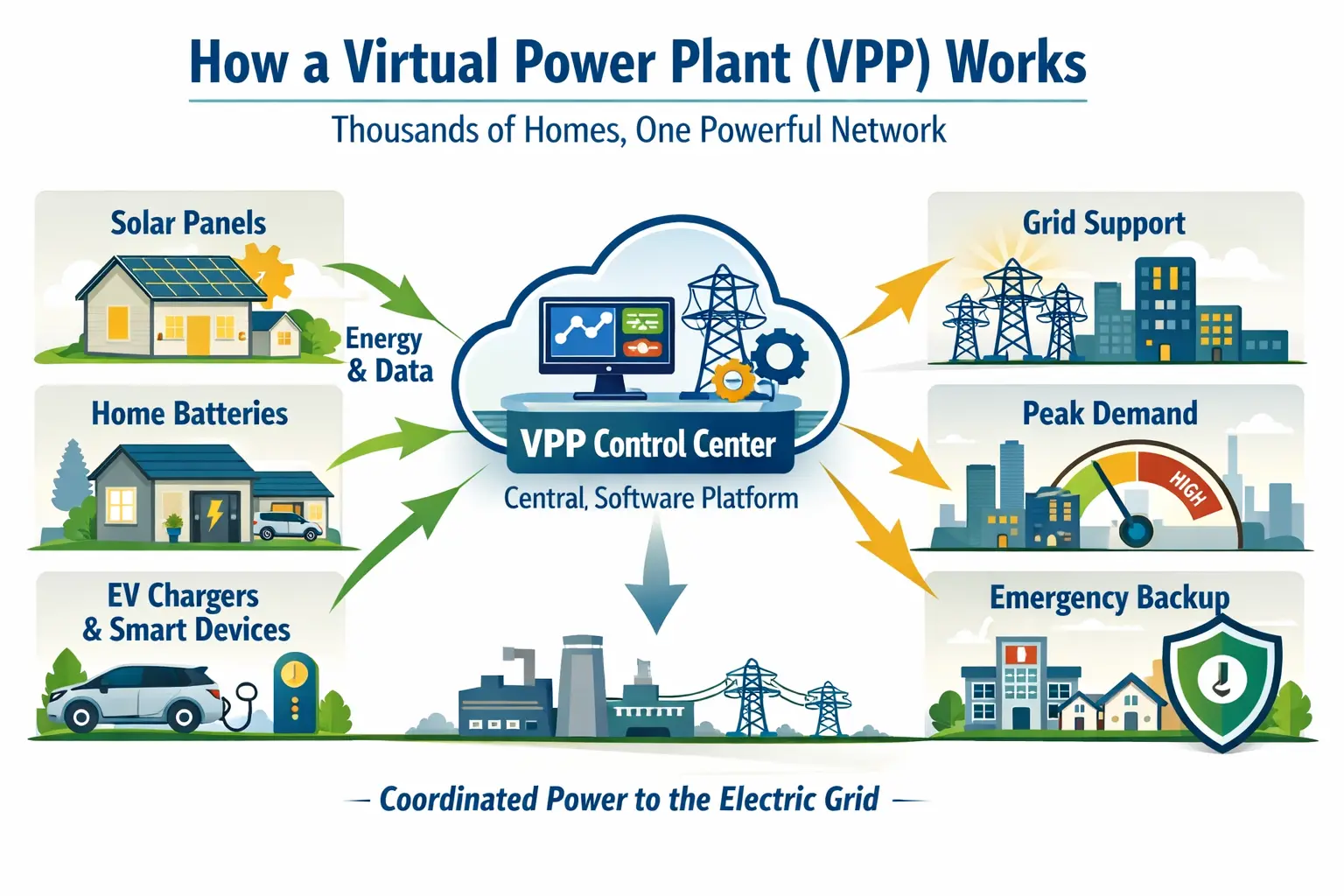
Millions of homes now produce electricity through rooftop solar. Many are adding home batteries that can store that energy and send it back to the grid when needed. When thousands of these homes are connected and coordinated by software, they can function like a single power plant.
This is called a Virtual Power Plant (VPP).
VPPs are rapidly becoming one of the most important tools utilities have to stabilize the grid, reduce blackouts, and integrate renewable energy at scale. For homeowners with solar and batteries, they can also unlock real financial incentives.
Let’s break down how virtual power plants work, why utilities are investing heavily in them, and what homeowners need to know about participating.
What Is a Virtual Power Plant?
A Virtual Power Plant (VPP) is a network of distributed energy resources — home batteries, solar systems, EV chargers, smart thermostats — that are connected and coordinated through software to operate like a single power plant.
Instead of generating electricity from one centralized facility, a VPP aggregates energy from thousands of smaller systems spread across homes and businesses. These systems are coordinated to:
- supply electricity during peak demand periods
- stabilize the grid in real time
- reduce the need for new fossil fuel peaker plants
- help utilities manage outages and grid stress events
In simple terms: a virtual power plant turns thousands of homes into one flexible, dispatchable power source.
How Virtual Power Plants Work
At the center of every VPP is software that manages distributed energy resources in real time. Here’s how a typical program operates.
Step 1: Homes Install Distributed Energy Resources
Participants install technologies that can generate, store, or manage electricity:
- Rooftop solar systems
- Home battery storage (Tesla Powerwall, Enphase IQ Battery, SolarEdge Home Battery, FranklinWH, sonnen)
- Smart thermostats
- EV chargers
- Smart water heaters
These devices are internet-connected and can communicate with grid operators in real time.
Step 2: The Systems Are Aggregated Through Software
Energy companies or VPP operators link these devices into a centralized platform. That platform monitors battery charge levels, solar production, electricity demand, and grid conditions simultaneously — and can coordinate thousands of devices at once.
Step 3: Energy Is Dispatched When the Grid Needs It
During high-demand events — heat waves, cold snaps, evening peak hours — the VPP operator can discharge small amounts of stored energy from thousands of batteries simultaneously.
Individually, each battery might supply just 5–10 kW. But aggregated across a large program, the collective output can be significant. As a benchmark, 10,000 homes with battery systems can deliver roughly 100–150 MW of dispatchable power — comparable to a small natural gas peaker plant.
Why Utilities Are Investing in Virtual Power Plants
Electric grids were designed for predictable demand and centralized generation. Today’s grid faces mounting pressure from multiple directions:
- Rising electricity demand driven by EVs and electrification
- Extreme weather events stressing infrastructure
- Rapid solar adoption creating mid-day generation surpluses and evening demand spikes
- An aging transmission system that’s expensive and slow to expand
Building new power plants or transmission lines can take years or decades and cost hundreds of millions of dollars. Virtual power plants can often be deployed faster, at lower cost, using resources that already exist in homes.
A landmark regulatory development accelerated this shift: FERC Order 2222, issued in 2020, opened wholesale electricity markets to aggregated distributed energy resources for the first time. That ruling gave VPP operators the legal framework to compete alongside traditional power plants in energy markets — and gave utilities a strong financial incentive to develop VPP programs rather than build new generation capacity.
The U.S. Department of Energy has identified VPPs as a key strategy for grid modernization, estimating that a national VPP build-out could avoid the need for tens of gigawatts of new power plant capacity. This approach is often called “grid flexibility,” and it’s becoming a core pillar of modern utility planning.
Virtual Power Plants vs. Demand Response: What’s the Difference?
These two terms are often confused, and it’s worth drawing a clear distinction.
Demand response programs ask customers to reduce their electricity consumption during peak periods — for example, by raising their thermostat a few degrees during a heat wave. The goal is to lower demand on the grid.
Virtual power plants go a step further. Instead of just reducing consumption, VPPs actively dispatch stored energy back to the grid. A home battery enrolled in a VPP doesn’t just stop drawing power — it can actually supply power to other homes and businesses.
That distinction matters for homeowners evaluating programs: demand response typically offers modest bill credits, while VPP programs often pay for actual energy dispatched, which can mean meaningfully higher compensation.
Why Home Batteries Are the Key Resource in VPPs
While many devices can participate in virtual power plants, home batteries are the most valuable asset. That’s because they can:
- Store excess solar energy during the day when production exceeds household demand
- Discharge electricity during evening peak hours when grid stress is highest
- Respond nearly instantly to grid dispatch signals
- Provide consistent, predictable output for hours at a time
Smart thermostats and EV chargers can shift demand, but they can’t inject power back into the grid. Home batteries can do both — which is why utilities and VPP operators are willing to pay a premium for battery-equipped households.
Real-World Virtual Power Plant Programs
VPPs are no longer theoretical. Programs are operating across the United States today, with growing scale.
Tesla Virtual Power Plant (California)
Tesla operates one of the largest residential VPP programs in the country through its Powerwall network. During a major grid emergency in California in September 2022, Tesla’s VPP dispatched over 16 MW of power from enrolled Powerwall batteries — a figure that has grown as the program has expanded. Participating homeowners receive per-event payments when their batteries are dispatched.
Sunrun and Ford VPP Programs
Sunrun has built VPP partnerships with utilities including Green Mountain Power in Vermont and National Grid in New England. Ford’s F-150 Lightning electric pickup also supports vehicle-to-grid (V2G) functionality, allowing the truck’s large battery pack to participate in VPP events alongside dedicated home storage systems.
Utility-Led Programs
Utilities themselves are launching and expanding VPP programs across the country. Active programs include those run by Pacific Gas & Electric (PG&E), Southern California Edison, Hawaiian Electric, and Green Mountain Power — which has been recognized nationally for its innovative approach to customer-sited battery integration. National Grid has active programs in the Northeast. These programs are expanding rapidly as battery adoption grows and regulators push utilities to develop grid flexibility resources.
How Homeowners Can Join a Virtual Power Plant
Not every solar system qualifies for VPP participation. To enroll, homeowners typically need:
- A home battery system
- An internet-connected inverter or energy management system
- A local utility or manufacturer VPP program available in their area
Battery systems that currently support VPP programs include the Tesla Powerwall, Enphase IQ Battery, SolarEdge Home Battery, FranklinWH, and sonnen battery systems — though program availability varies by utility territory and state.
Participation is typically optional and voluntary. Homeowners allow the VPP operator to draw small amounts of stored energy during designated peak demand events, usually while maintaining a minimum backup reserve so the battery is still available for home outage protection.
Availability varies significantly by state. California and Hawaii currently have the most developed VPP ecosystems, with multiple programs operating across different utilities and manufacturers. Texas operates under the ERCOT market structure, which has its own rules for distributed resource aggregation. Many other states are in earlier stages of program development as FERC Order 2222 implementation continues to roll out through state-level proceedings.
How the Economics Work: What Homeowners Actually Get Paid
The compensation structure varies by program, but most VPP payments fall into one or more of these categories:
- Capacity payments: a fixed annual stipend for enrolling your battery and making it available to the grid, regardless of how often it’s dispatched
- Per-event payments: compensation each time your battery is actually dispatched during a grid event
- Energy export payments: payment based on the volume of electricity your battery exports to the grid
Payment ranges vary widely. Some programs pay $100–$200 per year in capacity payments. Others structured around per-event dispatch can pay more in high-demand years when grid events are frequent. The most active programs — particularly in California and Hawaii — can provide $300–$500 or more annually for homeowners with larger battery systems in high-dispatch years.
It’s worth noting that VPP payments typically don’t replace the core value of your battery system — backup power and solar self-consumption. They’re additive revenue on top of what you’re already getting from storage.
Additional Benefits for Homeowners
Better Use of Your Battery
Most home batteries sit at or near full charge the majority of the time, waiting for an outage that may never come. VPP enrollment puts that stored capacity to work, generating value from an asset that would otherwise be idle.
Supporting Grid Stability and Clean Energy
VPPs help utilities reduce reliance on gas peaker plants — facilities that run only during peak demand and tend to be among the highest-emitting generators on the grid. By dispatching stored solar energy instead, homeowners with VPP-enrolled batteries are actively displacing fossil fuel generation during the hours it matters most.
Limitations and Tradeoffs to Understand
VPPs are a genuinely promising technology, but a balanced picture requires acknowledging some real limitations.
- Battery degradation: Frequent charging and discharging cycles contribute to battery degradation over time. Most manufacturers account for VPP use within their warranty terms, but it’s worth reviewing your specific battery’s warranty before enrolling in a high-dispatch program.
- Program availability is uneven: VPP programs are still nascent in many states. Homeowners outside California, Hawaii, and a handful of Northeast markets may find limited or no programs available today — though this is changing as FERC Order 2222 implementation continues.
- Dispatch is outside your direct control: During grid events, the VPP operator controls when your battery discharges. Most programs maintain a minimum backup reserve, but homeowners should understand and get comfortable with the program’s terms before enrolling.
- Payments are variable: VPP revenue depends on how often grid events occur, which varies year to year. Homeowners shouldn’t plan on VPP payments as reliable fixed income.
Are Virtual Power Plants the Future of the Grid?
The evidence is building that VPPs will become a core component of modern electricity systems — not a niche application.
The Rocky Mountain Institute has projected that VPPs could supply 60 GW of peak capacity in the U.S. by 2030. The U.S. Department of Energy has framed distributed energy resource aggregation as a central strategy for grid modernization and decarbonization. Utilities that once viewed residential batteries as a curiosity are now designing programs around them as a formal grid resource.
The economics are compelling: deploying a VPP using existing customer-sited batteries is often faster and cheaper than building new generation capacity. And as battery adoption accelerates with falling costs and growing EV penetration, the aggregate capacity of these distributed resources will grow substantially.
For homeowners already investing in solar and storage, virtual power plants represent one of the most tangible ways to earn a return on that investment while contributing to a more resilient, cleaner grid.
Frequently Asked Questions
Frequently Asked Questions
A virtual power plant is a network of distributed energy resources — like home batteries and solar systems — that are coordinated through software to operate like a single power plant. Instead of one central facility, the “plant” is made up of thousands of homes working together.
Demand response programs ask you to reduce your electricity use during peak periods. VPPs go further — your home battery actively exports stored energy back to the grid. The distinction matters financially: VPP programs typically pay more because you’re supplying power, not just cutting consumption.
Not always. Some VPP programs accept battery systems that charge from the grid as well as from solar. However, solar + battery systems are the most common participants because they can store excess daytime generation for evening dispatch.
Payments vary widely by program, location, and how often your battery is dispatched. Many programs offer $100–$500 per year. In high-dispatch years in markets like California and Hawaii, some homeowners with larger systems earn more. Think of it as supplemental revenue, not a primary income stream.
Typically only small amounts of energy are dispatched during events. Most programs also maintain a minimum backup reserve — often 20–30% of battery capacity — so your home still has outage protection. Review the specific program terms to understand how your reserve is handled.
Frequent cycling does contribute to battery degradation over time, though most major manufacturers’ warranties account for VPP use. Enphase, Tesla, and SolarEdge, for example, all support approved VPP programs without voiding warranties under standard terms. Confirm your specific battery’s warranty before enrolling.
Program availability varies significantly. California and Hawaii have the most developed VPP ecosystems. Vermont, Massachusetts, and New York have active programs through utilities like Green Mountain Power and National Grid. Many other states are in earlier stages. Your solar installer or battery manufacturer is often the best starting point for finding programs available in your utility territory.
Yes. VPP operators follow strict rules set by utilities and grid operators. Participation is voluntary, and homeowners can typically opt out of individual events if needed. The software controls are similar to what utilities already use to manage demand response programs.
Final Thoughts
Virtual power plants represent one of the most significant shifts in how electricity systems operate — a move from centralized generation toward a distributed, flexible grid built in part from the energy resources already installed in millions of homes.
Solar panels, home batteries, electric vehicles, and smart devices are no longer just household amenities. They’re becoming active participants in the energy system, and VPPs are the mechanism that makes that participation possible at scale.
For homeowners already investing in solar and storage, VPP programs offer a way to earn additional returns on those systems while directly supporting grid resilience and clean energy. As battery adoption accelerates and programs expand into more markets, virtual power plants are likely to become an increasingly standard feature of the solar + storage value proposition.
If you’re evaluating a home battery system and want to understand which programs are available in your area, connecting with a vetted local installer is a good starting point. They can help you identify which batteries qualify for local VPP programs and what compensation you might expect.