
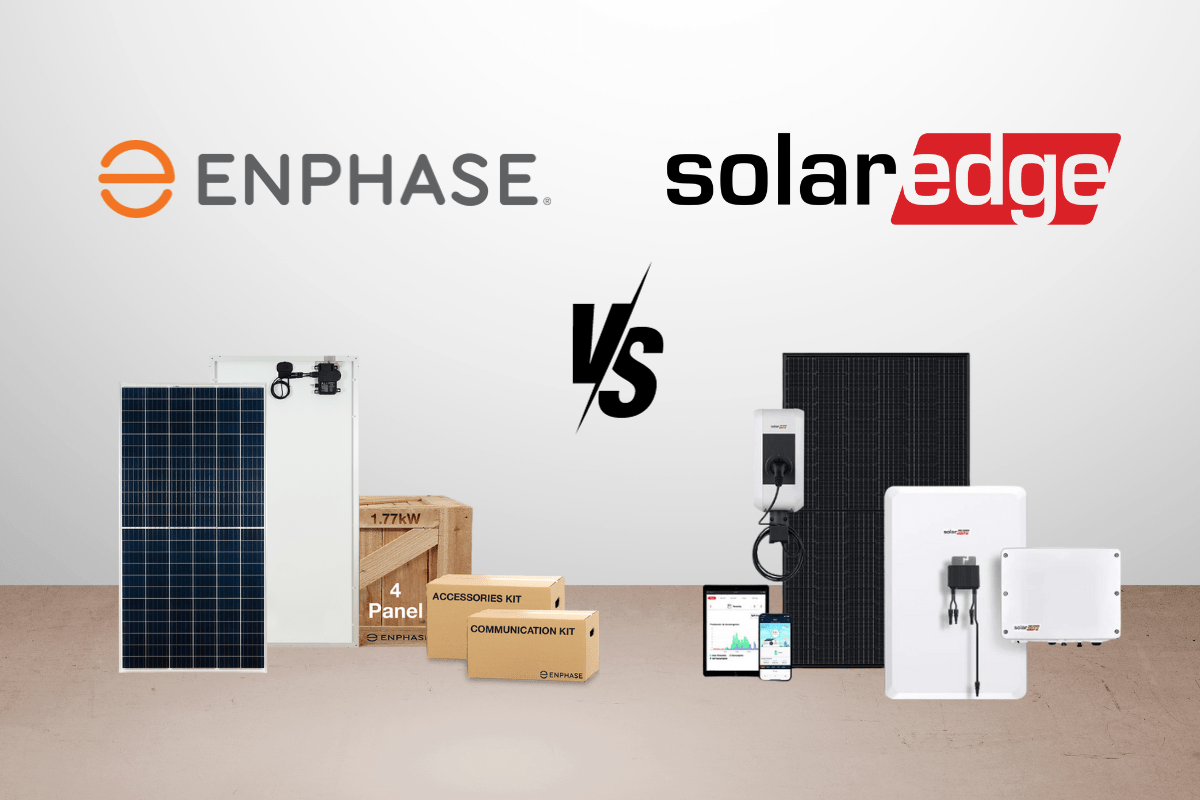
Choosing the right inverter platform is one of the most important decisions in a residential solar system. Two brands dominate the U.S. market: SolarEdge and Enphase.
Both technologies use Module Level Power Electronics (MLPE), allowing each solar panel to operate independently for improved performance, monitoring, and safety. But they take very different technical approaches.
SolarEdge uses DC power optimizers paired with a centralized inverter, while Enphase uses microinverters mounted on each individual panel, converting power to AC directly on the roof.
Neither system is universally better. The right choice depends on your roof design, electrical panel capacity, tolerance for downtime, monitoring preferences, and battery or expansion plans.
This guide explains how each system works and highlights the real-world tradeoffs homeowners should understand before choosing an inverter platform.
What Does a Solar Inverter Actually Do?
Solar panels produce direct current (DC) electricity, but homes run on alternating current (AC). The inverter converts DC electricity into usable power for your home.
Modern inverter systems also handle panel performance optimization, system monitoring and diagnostics, rapid shutdown safety requirements, and grid interaction and energy export.
Because the inverter controls how electricity flows through your system, its architecture plays a major role in reliability, long-term serviceability, and how well the system fits your home.
First, a Quick Clarification: These Are Both MLPE Systems
Both SolarEdge and Enphase fall under Module Level Power Electronics (MLPE)—meaning each solar panel has dedicated electronics that manage performance and safety at the panel level. This differs from traditional string inverter systems, where multiple panels are wired together and controlled as a single group.
MLPE became the residential standard because it offers better performance on roofs with shade or panel mismatch, panel-level monitoring instead of system-only visibility, enhanced rapid shutdown safety features, and greater flexibility for complex roof layouts.
SolarEdge vs Enphase: Side-by-Side Comparison
| Category | SolarEdge | Enphase | What this means for homeowners |
|---|---|---|---|
| MLPE type | DC optimizers + central inverter | Microinverter on each panel | Same category, different architecture |
| DC → AC conversion | Central inverter | At each panel | Centralized vs distributed |
| Single point of failure | Yes | No | SolarEdge downtime can affect full system |
| Failure impact | System-wide if inverter fails | Usually affects one panel | Enphase failures are less disruptive |
| Panel sizing flexibility | High | Limited by microinverter rating | SolarEdge supports larger panels |
| Shade performance | Strong | Strong | Both can outperform string inverters |
| Complex roof layouts | Good | Excellent | Enphase often preferred |
| Electrical panel impact | Often more flexible | Can trigger MPU in some homes | Depends heavily on installer design |
| Monitoring | Panel-level | Panel-level | Enphase app often more intuitive |
| System expansion | May require inverter upgrade | Easy panel-by-panel expansion | Enphase more modular |
| Battery architecture | DC-coupled | AC-coupled | See battery section below |
| Typical cost | Often lower | Often higher | Installer and market dependent |
SolarEdge vs Enphase: AC vs DC System Architecture
At the core of this comparison is one key question: where does DC power get converted to AC?
SolarEdge: DC-Based MLPE
SolarEdge uses DC power optimizers installed behind each panel. These optimizers manage panel performance, but electricity stays DC until it reaches a central inverter, which converts it to AC for your home.
Panel → Optimizer → DC → Central Inverter → AC → Home
Enphase: Fully AC-Based MLPE
Enphase uses microinverters mounted on each panel. Each microinverter converts DC power to AC directly at the panel, distributing power conversion across the entire system.
Panel → Microinverter → AC → Home
This architectural difference drives most of the real-world tradeoffs discussed below.
Reliability: What Actually Breaks in Solar Systems
Solar panels themselves rarely fail. In most systems, power electronics are the components most likely to need attention over time.
SolarEdge
The central inverter is a known wear component. Replacement over the life of the system is common and expected. When the inverter fails, the entire system goes offline until it’s repaired or replaced. That said, SolarEdge inverters are widely serviced and replacement is typically straightforward for a qualified installer.
Enphase
Individual microinverter failures do occur, but because each panel operates independently, a single failed unit affects only that panel—the rest of the system continues producing. Enphase backs microinverters with a 25-year warranty, which provides meaningful long-term protection.
In both cases, installer responsiveness often matters more than equipment brand when service is needed.
Performance in Shade and Complex Roof Layouts
Both SolarEdge and Enphase handle shade significantly better than traditional string inverters, allowing each panel to operate independently when some panels are shaded, roof planes face different directions, or panels have different tilt or orientation.
For simple roofs with minimal shading, the difference between the two platforms is negligible. For complex roofs with multiple orientations or significant shade, Enphase’s fully distributed architecture can offer a slight edge—there’s no central inverter to act as a bottleneck.
Power Clipping
SolarEdge: Because power stays DC until reaching the central inverter, clipping happens at the system level. Careful system sizing by an experienced installer can often minimize clipping in practice.
Enphase: Each microinverter has a fixed maximum AC output. When panel output exceeds that rating during peak sun hours, some production can be clipped. In most climates and with standard panel sizes, the impact is modest.
Neither platform has a decisive advantage here—it depends on the specific system design.
Electrical Panels and Main Panel Upgrades (MPU)
Enphase (AC-based): Because power is converted to AC on the roof, it must be backfed into your electrical panel. In homes with limited panel capacity, this can sometimes require a Main Panel Upgrade to meet electrical code.
SolarEdge (DC-based): Because DC power is converted at a single inverter location, installers sometimes have more flexibility in how solar integrates with the electrical panel—though MPUs still depend on panel size, local code, and installer design.
No inverter platform universally avoids this issue. If your electrical panel is older or near capacity, discuss it directly with your installer regardless of which platform you choose.
Batteries and Backup Power
If energy storage is part of your plan—now or in the future—inverter architecture plays a direct role.
SolarEdge typically integrates with DC-coupled batteries. DC coupling is generally efficient for solar charging because power doesn’t need to be converted from DC to AC and back again before storing. SolarEdge’s battery integration is tightly designed and works well in purpose-built solar-plus-storage systems.
Enphase uses AC-coupled batteries (the IQ Battery line). AC coupling adds a conversion step, but it offers flexibility—it’s easier to add storage to an existing system later, and Enphase’s modular approach makes expanding capacity straightforward.
If you’re planning to add batteries at some future point rather than installing now, Enphase’s retrofit flexibility is a genuine advantage.
Monitoring and the Homeowner Experience
Both platforms offer panel-level monitoring, but the day-to-day experience differs.
SolarEdge provides detailed performance data and advanced system diagnostics, often preferred by technically inclined homeowners who want granular visibility.
Enphase offers a clean, visual interface with simple alerts that most homeowners find intuitive and easy to act on.
Most homeowners check monitoring occasionally rather than daily—but when something underperforms or goes wrong, ease of understanding matters.
SolarEdge: Pros and Cons
Pros
- Often lower upfront system cost
- Panel-level monitoring and optimization
- DC-coupled battery integration is efficient for solar charging
- Flexible design options, including support for larger panels
- Central inverter is a known, serviceable component
Cons
- Central inverter is a single point of failure—system goes offline when it fails
- Inverter replacement is expected over the system’s life
- Expanding the system may require an inverter upgrade
- System downtime during inverter service can last days depending on availability
Enphase: Pros and Cons
Pros
- No single point of failure—one failed unit affects only one panel
- 25-year microinverter warranty
- Modular expansion: add panels without inverter changes
- Easier battery retrofits
- Homeowner-friendly monitoring app
Cons
- Higher upfront system cost
- More electronics mounted on the roof (more potential failure points over time)
- AC-coupled battery storage adds a conversion step
- Microinverter rating can limit compatibility with very large panels
Which Inverter Is Right for Your Home?
SolarEdge may be a better fit if you:
- Have a simple roof with minimal shading
- Are prioritizing lower upfront cost
- Plan to install DC-coupled batteries as part of a solar-plus-storage system
- Have an installer experienced with SolarEdge design
Enphase may be a better fit if you:
- Have a complex roof with multiple orientations or meaningful shade
- Value redundancy—you don’t want one component to take down the whole system
- Want flexibility to add panels or batteries incrementally over time
- Prefer a simpler monitoring experience
Frequently Asked Questions
Frequently Asked Questions
Neither is universally better. SolarEdge tends to work well on simpler roofs and can cost less upfront. Enphase offers more redundancy and modular flexibility. The right choice depends on your roof, budget, and long-term plans.
Both are highly reliable. The key difference is failure impact: a SolarEdge central inverter failure takes the whole system offline, while an Enphase microinverter failure affects only one panel. Enphase’s 25-year microinverter warranty also provides stronger long-term coverage.
Not as a rule. Production differences are usually driven by system design, roof layout, and shading conditions—not the inverter platform itself. Both outperform traditional string inverters in real-world residential conditions.
Yes. If the central inverter fails, the system stops producing until it’s replaced. Inverter replacement is a normal part of system ownership and is typically straightforward, but it does mean downtime.
They’re different approaches to the same goal. Microinverters (Enphase) convert DC to AC at each panel. Power optimizers (SolarEdge) condition DC power at each panel but send it to a central inverter for conversion. Microinverters offer more redundancy; optimizers offer more design flexibility and often lower cost.
SolarEdge typically uses DC-coupled batteries, which are efficient for solar charging. Enphase uses AC-coupled batteries, which are more flexible for retrofits and incremental expansion. If you’re adding storage now, either works well. If you’re planning to add storage later, Enphase’s AC-coupled approach is easier to retrofit.
Final Thoughts
SolarEdge and Enphase are both proven, professional-grade platforms installed in millions of homes across the country. In the right hands, either system will perform well for decades.
The best inverter is often the one your installer knows best. A well-designed SolarEdge system will outperform a poorly installed Enphase system—and vice versa. When you’re comparing quotes, pay attention to how installers explain their design choices, not just what brand they’re proposing.
EnergyScout connects homeowners with vetted local installers who can evaluate your specific roof, electrical panel, and energy goals—and recommend the platform that actually fits your home.