
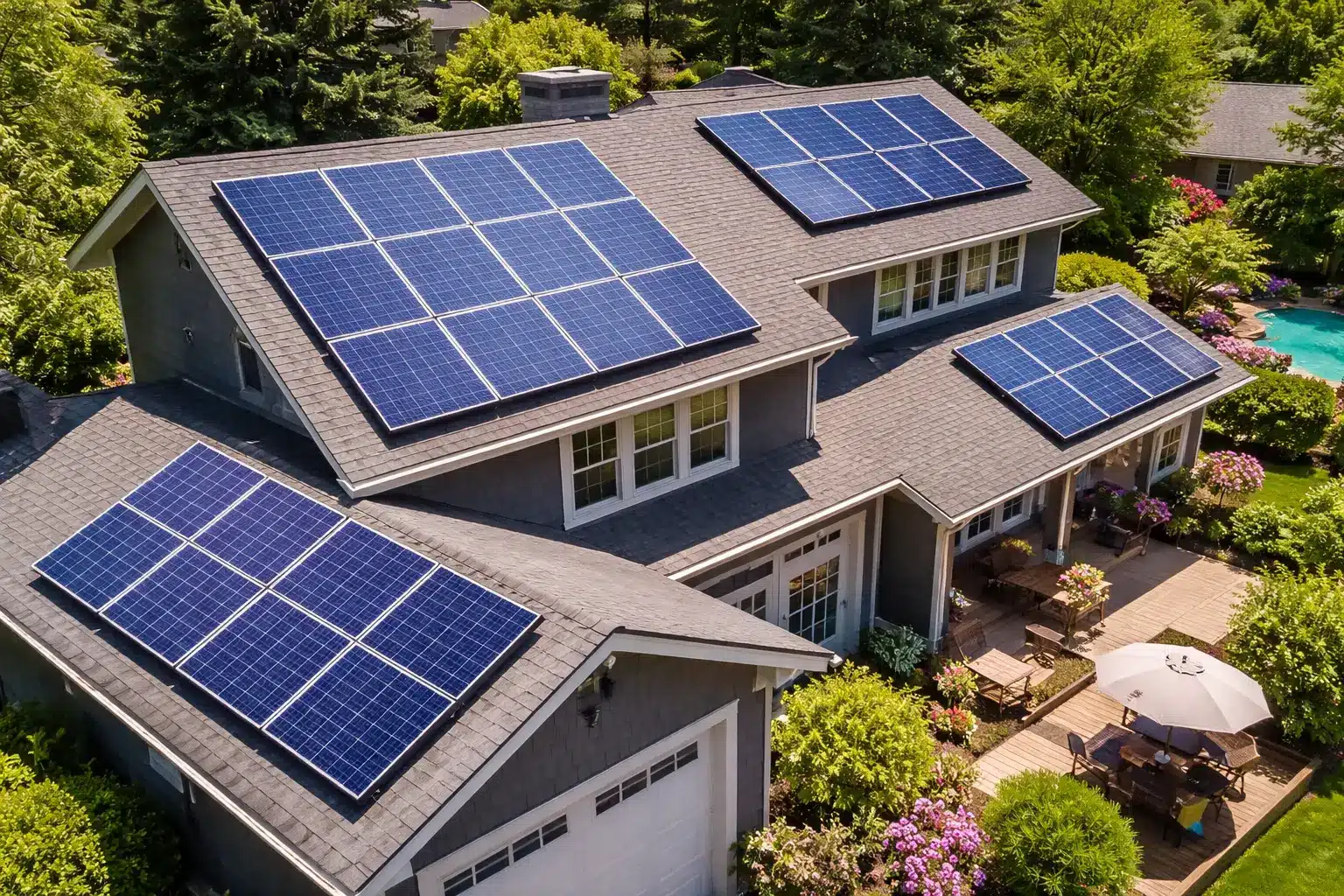
Most homeowners don’t buy a house because the roof was engineered for solar. Yet for millions of Americans evaluating solar panels, the roof is where the decision actually starts — not with the equipment, not with the installer, and not with the monthly payment.
The ideal solar roof checks every box: south-facing, composition shingle, minimal shade, and at least 500 square feet of open space. Very few roofs hit all five. But here’s what that list doesn’t tell you: a roof doesn’t have to be perfect to be productive.
Modern panel technology, smarter inverter design, and flexible racking systems give installers more options than ever to work around common limitations. The real question isn’t whether your roof is perfect — it’s whether the five key factors tip in your favor.
The 5 Factors That Determine If Your Roof Is Good for Solar
1. Roof Orientation (Direction)
The direction your roof faces is one of the biggest drivers of how much electricity your solar system will produce over its lifetime.
In the continental United States, south-facing roofs capture the most sunlight throughout the day because the sun arcs across the southern sky. A well-positioned south-facing system with no shade is the benchmark every installer designs toward.
East- and west-facing roofs perform well — typically producing 10–15% less annually than an equivalent south-facing system. That’s a manageable difference, not a dealbreaker. In some cases, the directional split actually works in your favor:
- Coastal areas with morning marine fog may actually favor west-facing panels that produce later in the day.
- Regions with afternoon thunderstorms — common across parts of Colorado and the Mountain West — can favor east-facing arrays that front-load production in the morning.
- If your utility uses time-of-use (TOU) pricing, west-facing panels may produce more electricity during peak-rate hours (typically late afternoon and evening), improving your financial return even with lower overall output.
North-facing roofs are generally not viable in the U.S. — sunlight angles are too low and inconsistent to justify the hardware cost. But the difference between south, east, and west is often more nuanced than a simple ranking suggests.
2. Roof Material and Remaining Lifespan
Solar panels are designed to last 25–35 years. If your roof isn’t going to outlast the system, you’re signing up for an expensive panel removal and reinstall mid-life. Roof condition and material type are both important.
Here’s how common roof types compare for solar installation:
| Roof Type | Solar Compatibility |
| Composition Shingle | ✅ Excellent — easiest, most common |
| Standing Seam Metal | ✅ Excellent — no roof penetrations needed |
| Flat Concrete Tile | ✓ Good — may need S-hook mounts |
| Spanish / S-Tile | ⚠ More complex — higher install cost |
| Slate | ⚠ Expensive / difficult — brittle material |
| Wood Shake | ✗ Often not suitable — fire risk + fragile |
| Stone-Coated Steel | ✗ Usually difficult — limited bracket options |
Composition shingles dominate U.S. residential roofing — and for good reason. They’re durable, easy to penetrate with standard lag bolts and flashing, and widely understood by every solar installer in the country.
Standing seam metal is actually one of the best surfaces for solar. Panels clamp directly to the raised seams without penetrating the metal surface at all, which eliminates leak risk entirely.
If your roof has less than 10 years of remaining life, most experienced installers will recommend replacing it before going solar. The cost of removing a solar system, replacing the roof, and reinstalling the panels typically runs $3,000–$6,000 or more — cost that’s entirely avoidable with a new roof first.
3. Available Roof Space
Solar panel output is directly tied to how many panels you can physically fit on your roof. A typical residential system requires 300–500 square feet of usable roof space — but “usable” is the key word.
Obstructions that eat into available space include:
- Chimneys and skylights
- Roof vents and HVAC equipment
- Dormers and valleys
- Fire setback requirements (typically 3 feet from ridges and edges, mandated by local code)
Some obstructions — like certain roof vents — can be relocated or replaced with low-profile alternatives before installation. Others are fixed constraints.
There’s also an important economic dimension to roof space. A significant portion of a solar installation’s cost is fixed regardless of system size: permitting, electrical work, inverter installation, and labor all apply whether you’re installing 8 panels or 24. Larger systems spread those fixed costs across more production capacity, which typically improves cost-per-watt and overall return on investment. A roof that can only accommodate a very small system may not pencil out financially even if conditions are otherwise good.
4. Number of Roof Planes
Roof space matters — but so does how that space is distributed. A home with 600 square feet of usable roof split evenly across three different surfaces creates a more complex installation than the same space on a single plane.
When panels span multiple roof faces, installers design what are called sub-arrays — separate groups of panels mounted at different orientations. Each additional sub-array adds:
- Additional racking and mounting hardware
- More electrical homerun wiring back to the inverter or combiner
- Increased labor time and installation complexity
- Greater visual variation across the roofline
In some cases, microinverters or DC power optimizers (from companies like Enphase or SolarEdge) are used to manage multi-orientation systems more efficiently — each panel operates independently, which reduces the performance penalty of mixing orientations.
But as a general principle: fewer arrays means lower cost, simpler wiring, and a cleaner-looking installation. If your roof’s usable space is concentrated on one or two planes, that’s a meaningful advantage.
5. Shade
Shade is one of the most significant variables in determining whether solar is worth pursuing — and one of the most frequently underestimated by homeowners at the research stage.
Common shading sources include trees (especially as they grow), neighboring rooftops, chimneys, and dormers on your own home. What makes shade tricky is that it’s seasonal. A roofline that looks perfectly open in July may be significantly shaded in December and January, when the sun sits lower in the sky — precisely when electricity bills tend to be highest.
Professional installers typically perform a shade analysis using software-based roof simulations. These tools measure the precise percentage of available sunlight across every hour of every month, giving you a realistic production estimate rather than a best-case number.
Shade doesn’t automatically disqualify a roof. Microinverters and DC power optimizers allow each panel to operate independently, so a shaded panel doesn’t drag down production across the entire system the way string inverters can. But heavy, persistent shading — more than 20–25% annual solar access loss — can significantly erode the financial case for going solar, even with the best mitigation technology.
The Bottom Line
Very few homes have a perfect solar roof. But perfection isn’t the standard — productivity is.
A roof that leans toward the positive side of all five factors — reasonable orientation, compatible material with years of life remaining, adequate square footage, minimal sub-arrays, and manageable shade — can support a solar system that delivers meaningful savings for decades.
For homeowners motivated by energy independence, long-term electricity cost control, or reducing their environmental impact, the right question isn’t “is my roof perfect?” It’s “does my roof support a system that makes financial sense?” A qualified installer can answer that question with real data — not estimates.
Frequently Asked Questions
Frequently Asked Questions
Most homes need 300–500 square feet of usable roof space for a standard system sized to offset a significant share of electricity usage. The exact amount depends on your household’s consumption, local sunlight hours, and the efficiency rating of the panels your installer specifies. Higher-efficiency panels produce more power per square foot, which can help on roofs with limited space.
No. South-facing roofs produce the most consistent annual output in the U.S., but east- and west-facing systems routinely perform well. Depending on your utility’s pricing structure — especially if time-of-use rates apply — a west-facing system can sometimes match or exceed the financial value of a south-facing one, even with slightly lower total production.
Yes, in many cases. Moderate shading doesn’t eliminate solar as an option, especially with modern inverter technology. Microinverters (like those from Enphase) and DC power optimizers (like SolarEdge) allow each panel to operate independently, so a shaded panel doesn’t pull down the entire system. A professional shade analysis will tell you exactly how much production impact to expect before you commit.
Asphalt composition shingles are the most straightforward and cost-effective roofing surface for solar — they’re the industry default. Standing seam metal roofs are also excellent candidates because panels clamp directly to the seams without penetrating the roof surface. Tile roofs can work well with the right mounting hardware, though they typically add some cost. Slate and wood shake are generally poor candidates due to fragility or fire risk.
If your roof has fewer than 10–15 years of useful life remaining, yes — replacing it before installation is usually the right call. Removing and reinstalling a solar array mid-system-life typically costs $3,000–$6,000 or more. A roofer and solar installer can often coordinate timing to minimize disruption and total cost. Ask your solar installer for their honest assessment of your roof’s condition before signing any contract.
Final Thoughts
Your roof is your most important solar asset — and also the one you have the least control over. Understanding how orientation, material, space, layout, and shade interact gives you a realistic baseline before you start talking to installers.
The homeowners who get the best outcomes from going solar are the ones who go in informed. They know what questions to ask, they understand the tradeoffs, and they aren’t surprised when a shaded tree or a complex roofline changes the math. A thorough roof evaluation — including a shade analysis and honest assessment of remaining roof life — should be part of every installation quote.
Even an imperfect roof can support a productive solar system. The key is knowing where your roof stands across all five factors before you make a decision.