
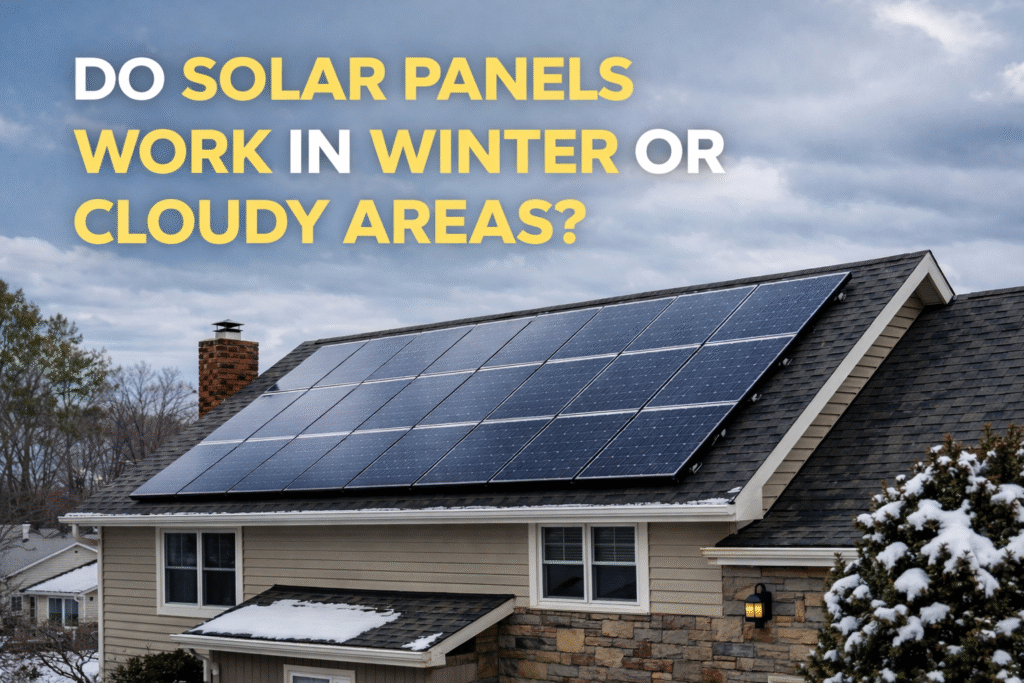
Short answer: yes, solar panels absolutely work in winter and in cloudy climates — and often better than people expect.
This question usually comes from homeowners who live in northern states, experience long winters, or deal with frequent cloud cover. Let’s break down how solar actually performs in these conditions, what to expect seasonally, and what does matter if you’re considering solar.
How Solar Panels Generate Power (Even Without Perfect Sun)
Solar panels don’t need bright, direct sunshine to produce electricity. They generate power from daylight, not heat, and they can capture both direct and diffuse sunlight.
On cloudy days, sunlight is scattered across the sky rather than blocked completely. That scattered light still reaches your panels — just at a lower intensity.
In practical terms:
- A fully cloudy day might produce 10–30% of a system’s normal peak output
- A partly cloudy day can produce much more
- Cool temperatures actually improve panel efficiency compared to extreme heat
Fun Fact: The “Edge-of-Cloud Effect”
There’s a lesser-known phenomenon called the edge-of-cloud effect.
When sunlight hits the edge of a cloud at the right angle, it can become briefly more intense than a clear blue sky due to light reflection and concentration. This can cause short production spikes that surprise homeowners watching their monitoring apps.
While total energy on cloudy days is still lower overall, this effect helps explain why solar production doesn’t drop to zero just because clouds roll in.
Solar Thrives in Cloudy Climates (Yes, Really)
Some of the world’s largest solar markets experience less annual sunlight than much of the U.S.
For example, Germany has a solar window that’s closer to northern U.S. states than to places like Arizona or California — yet it remains one of the most successful solar adopters globally.
The key takeaway:
- Solar works reliably in cloudy regions
- System design accounts for local sunlight conditions
- Annual production matters more than any single day
What Happens to Solar Panels in the Winter?
Winter does reduce total solar production, but usually less than homeowners expect.
Shorter Days = Less Total Energy
The biggest factor in winter isn’t snow or cold — it’s simply fewer daylight hours.
Snow Typically Clears Faster Than You’d Think
Solar panels are usually installed on roof planes that:
- Face the sun
- Are angled to optimize production
These same factors help snow melt and slide off faster than on other roof sections. In many cases, panels are exposed again within a day or two of snowfall.
Cold Weather Is Actually Good for Solar
Solar panels are more efficient in cooler temperatures. Cold, sunny winter days can produce surprisingly strong output once panels are clear.
Cloudy Days vs. Shaded Panels (This Matters)
Here’s an important distinction homeowners often miss:
- Clouds reduce production
- Shade can destroy production
Trees, chimneys, neighboring buildings, or roof obstructions that cast shade on panels — even for part of the day — can significantly reduce output. Shade is one of the biggest long-term performance killers for solar systems.
This is why:
- Professional shade analysis is critical
- System design matters as much as equipment
- Tree growth over time should be considered
Solar works in cloudy weather. It does not work well in the shade.
What Homeowners Are Really Asking When They Ask This Question
When people ask whether solar works in winter or cloudy areas, they’re usually wondering:
- Will solar still offset my electric bill year-round?
- Will I need to rely on the grid more in winter?
- Is solar “worth it” in my climate?
- Will snow damage my panels?
- Will production drop to zero on bad weather days?
The honest answer is that solar is designed around annual performance, not daily perfection. Your system is sized to produce enough energy over the course of a year — even if winter months produce less than summer months.
Bottom Line
- Solar panels do work in winter and cloudy areas
- Cloudy days still produce meaningful energy
- Snow usually clears faster than expected
- Cold temperatures improve efficiency
- Shade (not clouds) is the real concern
- System design matters more than climate alone
Solar is not just for sunny deserts — it’s a proven technology across a wide range of climates.
Helpful Next Steps
- 👉 Read Solar 101: How Home Solar Works and Whether It’s Right for You
- 👉 Learn How Solar Panels Work: A Simple Guide for Homeowners
- 👉 Explore Is My Roof Good for Solar? (shade, orientation, and design)