
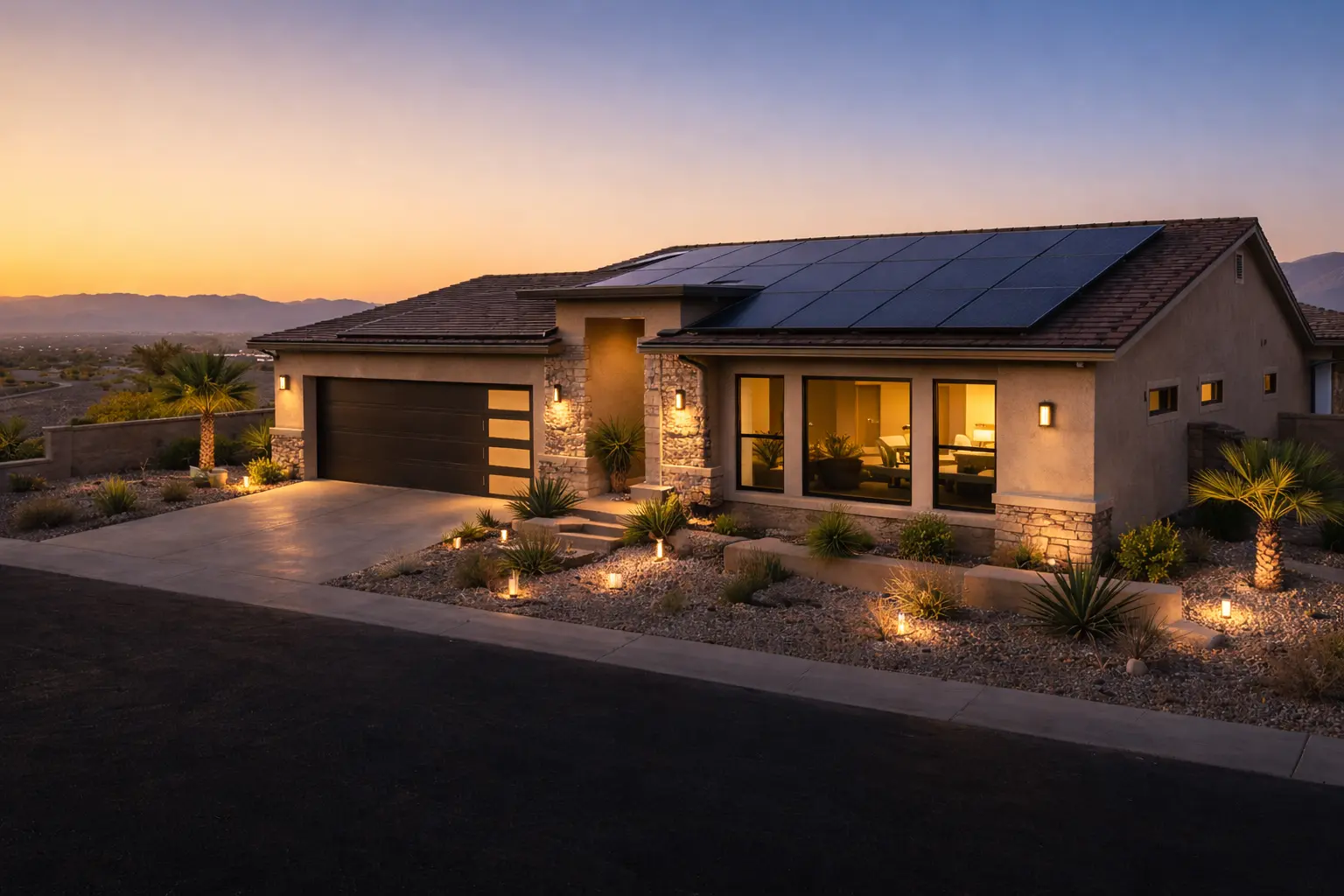
Reno sits at roughly 4,500 feet elevation in the Great Basin — high, dry, and sunny in a way that produces excellent solar output year-round. The city averages over 300 sunny days annually, and while winters bring cold temperatures and occasional snow, solar panels continue producing meaningful energy even in January. Snow slides off tilted panels relatively quickly, and the intense high-elevation summer sun more than compensates for shorter winter days.
The economics are solid but measured. NV Energy’s Northern Nevada residential rate runs approximately $0.14/kWh — below the national average and well below California rates. Average Reno households spending roughly $170/month on electricity and consuming around 1,185 kWh/month represent a meaningfully larger usage profile than Las Vegas, because Reno’s four-season climate drives both summer cooling and winter heating loads. Higher usage generally supports stronger solar economics.
EnergySage puts the average Reno installation cost at $2.33/watt (February 2026) for an average system size of about 11.2 kW. The average payback period is approximately 9.9 years cash purchase, with 25-year lifetime savings estimated at $31,037. That’s a meaningful return, though notably lower than Las Vegas ($57,000 over 25 years) — because Las Vegas rates are higher and AC loads create enormous offset opportunity. The strongest case for Reno solar is the long-term rate hedge: NV Energy has proposed substantial rate increases in recent years, and locking in today’s solar production protects against that trajectory.
NV Energy serves all Reno, Sparks, Carson City, and surrounding Northern Nevada addresses through its Sierra Pacific Power Company division. The net metering program is governed by Nevada’s Assembly Bill 405 (2017).
How NV Energy net metering works: Solar energy you produce and consume at home offsets your grid electricity at full retail rate within each netting interval. Surplus your panels produce beyond your home’s needs earns a credit at the Tier 4 rate — 75% of retail, approximately $0.10/kWh for Northern Nevada customers. Those credits roll forward indefinitely for the full 20-year term of your interconnection agreement, locked at that rate regardless of future program changes.
The October 2025 change — what it means: Starting October 1, 2025, NV Energy began placing all new Northern Nevada solar customers on the NMR-2025 tariff, which calculates netting in 15-minute intervals rather than monthly. Existing solar customers who interconnected before October 1, 2025 remain on monthly netting and are not affected.
Under monthly netting: your total solar production for the month offsets your total consumption for the month. Under 15-minute netting: each 15-minute window is settled independently. Solar overproduction in a sunny afternoon window earns a 75% export credit rather than being banked at full retail value against nighttime consumption. NV Energy estimates this adds approximately $11/month to new solar customers’ bills relative to monthly netting.
Legal challenges: The Nevada Attorney General’s Bureau of Consumer Protection, Vote Solar, Solar United Neighbors, and other advocates have filed legal challenges arguing the 15-minute netting violates AB 405. Those challenges were pending as of early 2026. Confirm the current status of this proceeding with your installer before signing.
What it means for system design: Under 15-minute netting, battery storage becomes more valuable. A battery that stores midday solar overproduction for use in the evening and overnight captures that energy at full retail value rather than exporting it at 75%. Installers should model the impact of 15-minute netting on your specific usage profile — and show you side-by-side economics with and without storage.
What Nevada offers — and what it doesn’t: Reno solar buyers face the same lean incentive landscape as Las Vegas: no state property tax exemption (your assessed value and property taxes increase after installation), no state sales tax exemption (Washoe County’s combined rate applies), and no state solar tax credit. The main financial incentives are NV Energy’s net metering program and the 20-year rate lock that comes with interconnection.
No demand charge in Reno: Unlike Southern Nevada, where NV Energy’s April 2026 residential demand charge is being implemented for Las Vegas customers, Northern Nevada customers do not have a mandatory demand charge. That’s an important distinction — Reno solar economics are not affected by a demand charge. The 15-minute netting change is the Reno-specific policy shift that matters.
Reno’s four-season climate and system sizing: Unlike Las Vegas, where summer AC drives the bulk of electricity consumption, Reno’s higher usage is spread more evenly across seasons — summer cooling, winter electric heating, and shoulder-season loads. Average system sizes here (~11 kW) are unusually large for Nevada; confirm with your installer that the proposed system is sized to your specific usage history, not a generic regional average.
HOA protections: Nevada’s Renewable Energy Bill of Rights protects your right to install solar regardless of HOA rules. HOAs may impose reasonable aesthetic restrictions but cannot prohibit installation.
Interconnection timeline: NV Energy processes Northern Nevada interconnection applications under Rule 15, with typical timelines of 8–14 weeks from contract to Permission to Operate. Confirm current queue times with your installer.