
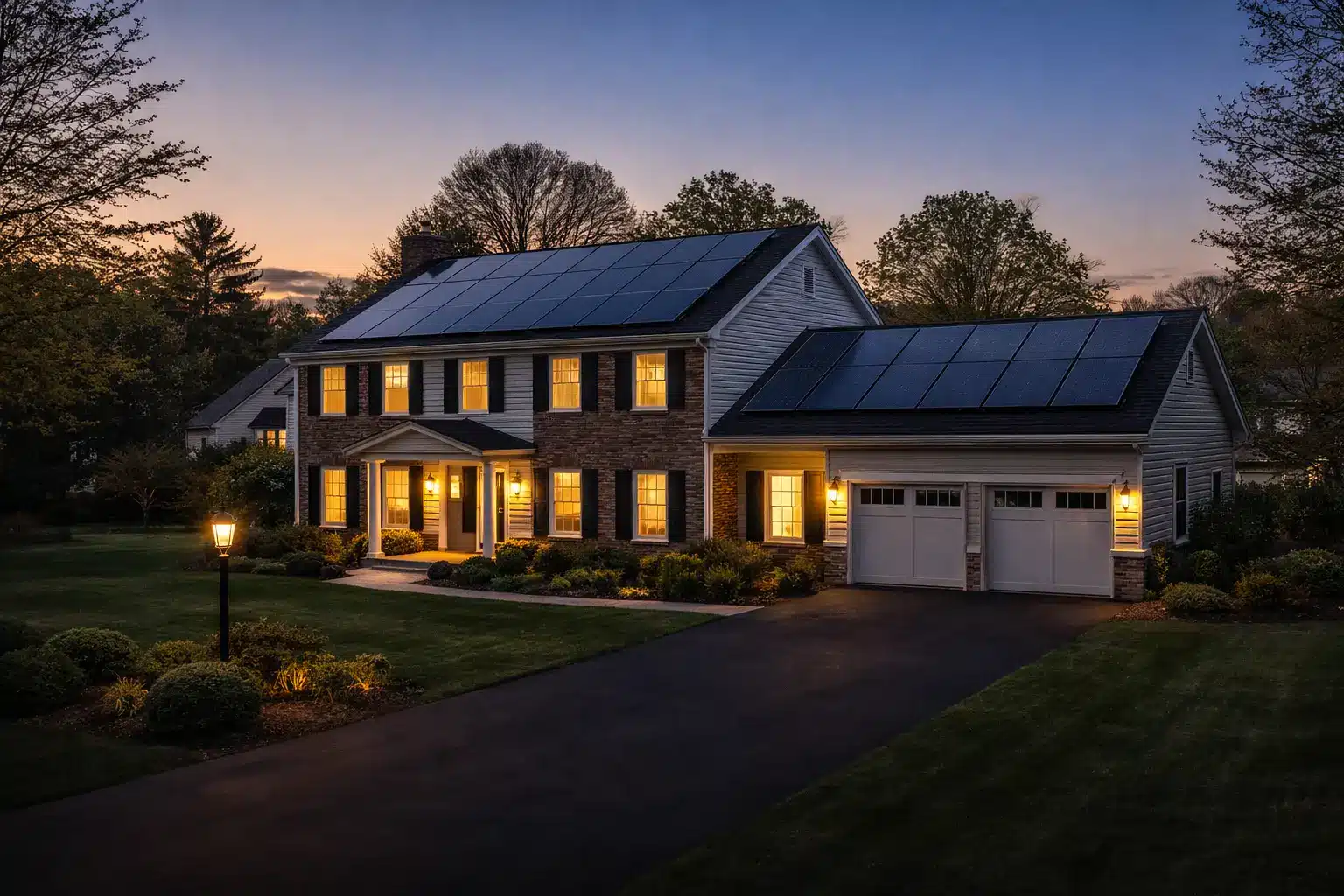
New Jersey offers four solar incentives that stack independently, and every Jersey City homeowner with a grid-connected rooftop system qualifies for all of them.
Net metering through PSE&G credits excess solar production at the full retail rate — roughly 18¢ per kilowatt-hour — and carries credits forward month to month. At year-end, any remaining surplus settles at avoided-cost (approximately 3–5¢/kWh), so sizing the system to match annual consumption rather than exceed it is the standard practice.
SREC-II under the state’s Successor Solar Incentive (SuSI) Program pays $90 per megawatt-hour of production for 15 years, locked in at interconnection. A 6–8kW rooftop system typical for a Jersey City brownstone or rowhouse produces roughly 7,000–9,000 kWh annually, generating 7–9 SREC-II certificates per year worth $630–$810 on top of bill savings. The program is capacity-based and remains open, though future batches may carry different pricing if the BPU adjusts rates as planned for review in 2026.
New Jersey’s sales tax exemption eliminates the 6.625% state sales tax on qualifying solar equipment at purchase — a savings of roughly $1,400–$1,800 on a typical Jersey City system. The property tax exemption prevents municipalities from reassessing home value upward due to solar installation, so the added home equity from panels doesn’t translate into a higher annual tax bill.
The federal 30% residential tax credit (25D) expired December 31, 2025, under the One Big Beautiful Bill. For Jersey City homeowners buying systems with cash or a loan in 2026, the incentive stack is state-only. One significant exception: third-party-owned systems — solar leases and PPAs — may still access the commercial Investment Tax Credit (48/48E, currently 30%) if construction begins before the phase-out threshold. Installers offering PPAs or leases typically price the federal credit savings into the contract rate, which is why PPA per-kWh rates in NJ have remained competitive despite the residential credit expiration.
Jersey City’s density and housing stock shape the solar conversation more than any incentive program. The city is predominantly high-rise residential towers along the waterfront and Journal Square, mid-rise condominiums in downtown and the Heights, and attached brownstones and two-to-four-family homes in neighborhoods like McGinley Square, Bergen-Lafayette, and Greenville. Owner-occupancy rates are low — Hudson County consistently ranks among New Jersey’s lowest for homeownership — meaning most Jersey City utility customers are renters who receive no solar benefit from panels a landlord might install.
For residents in high-rise condominiums and apartment buildings, rooftop solar is almost never a direct option. Common-area roofs are controlled by HOAs or building owners, individual units cannot independently install panels, and even buildings that pursue commercial rooftop systems typically don’t pass production credits through to individual unit utility bills.
For residents in attached brownstones and row-style homes — particularly south of Journal Square and in the West Side — rooftop solar is physically possible if the owner occupies the unit. These homes typically accommodate 8–16 panels (3–7kW), constrained by roof pitch, row-house span, and shading from adjacent structures or stairwell bulkheads. Adjacent taller buildings are a more significant shading factor in Jersey City than in lower-density Newark, particularly on north-facing or east-facing exposures. A shading analysis from a reputable installer is essential before committing; systems on partially shaded Jersey City rooftops underperform projections significantly without microinverters or power optimizers.
Condominium unit owners face a specific structural barrier: net metering and SREC-II eligibility require the system to be grid-connected and registered in the account holder’s name. A condo owner cannot unilaterally install panels on a common-area roof. HOA-coordinated projects are possible in principle but require board authorization, shared ownership structures, and agreement on how credits are allocated — administratively complex and rarely pursued.
For the majority of Jersey City residents who rent or live in condominiums without rooftop access, community solar is the practical solar participation path. New Jersey’s Community Solar Energy Program (CSEP) allows any PSE&G customer to subscribe to an off-site solar project and receive bill credits reflecting the project’s discounted electricity rate — no panels, no installation, no landlord permission required.
Governor Murphy signed legislation in August 2025 unlocking an additional 3,000 MW of community solar capacity statewide, significantly expanding access after earlier blocks sold out rapidly. In the April 2025 CSEP enrollment period, the PSE&G block was oversubscribed — the acceptance threshold landed at a 41% bill credit discount, meaning subscribers in that block are receiving credits at 41% below the standard PSE&G rate. Future enrollment windows are expected as new projects register under the expanded capacity authorization. Subscribers on the NJBPU project finder can locate open PSE&G-territory projects by zip code.
For a Jersey City PSE&G customer using 500 kWh monthly at 18¢/kWh — a modest bill of around $90 — a 41% discount on the community solar portion would reduce costs by roughly $37/month, or about $440 annually, with no upfront cost and no change to the utility relationship. Low- and moderate-income households qualify for guaranteed minimum 15% discounts and can access priority enrollment in dedicated LMI-reserved capacity.
Renters should note that community solar enrollment is tied to the PSE&G account, not the apartment. Subscribers who move must update or transfer their subscription, and most CSEP contracts include termination provisions. Read contract terms carefully, particularly around minimum subscription periods and what happens if you relocate within or out of PSE&G territory.
Est. 2010
Est. 2014
Est. 2009
Est. 2009
Est. 2011
Est. 2017
Est. 2015
Est. 2009
Est. 2007
Est. 2006