
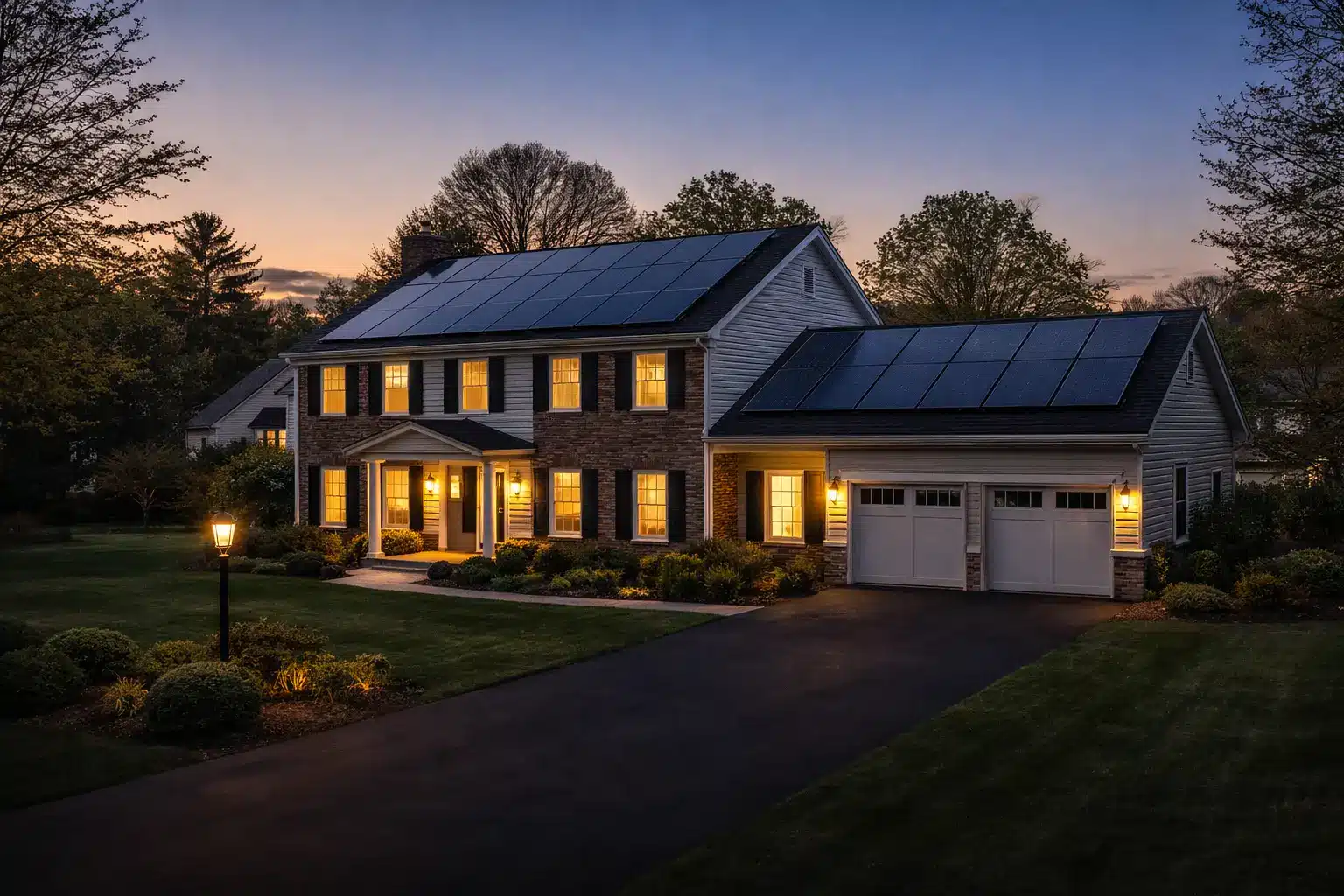
Virginia’s net metering policy for Dominion Energy customers stands in sharp contrast to the Duke Energy markets covered elsewhere in this dataset. Where Charlotte and Raleigh homeowners on the Net Metering Bridge receive only 3.4¢/kWh for energy exported to the grid, Arlington homeowners on standard Dominion net metering receive credit at the full retail rate — currently approximately 16¢/kWh — for every kilowatt-hour their solar system exports. There are no monthly capacity charges tied to system size, no minimum monthly bill specifically imposed on solar customers, and no export penalty that makes oversizing dangerous. Credits accumulate month-to-month throughout the year; any surplus remaining at the end of the annual billing cycle can be carried forward into the following year or paid out at Dominion’s avoided cost rate of approximately 3 to 5¢/kWh.
This structure inverts the sizing logic from the NC NMB markets. In Charlotte and Raleigh, a homeowner who installs too much capacity and exports heavily suffers material ROI damage from the 3.4¢ export rate. In Arlington, a homeowner who installs a well-sized system and exports summer surplus banks those credits at full retail value to draw down on winter nights — a true seasonal banking mechanism. The practical ceiling is Dominion’s 20kW residential interconnection cap and the physical constraint of available roof space, which in Arlington is often the binding constraint rather than policy.
Dominion also offers an optional Off-Peak Plan time-of-use rate with a one-time $500 incentive for solar customers who enroll. Under TOU, off-peak rates are lower than the standard flat rate and on-peak rates are higher. Solar arrays that face west generate more electricity during the late afternoon on-peak window and can extract additional value from TOU. South-facing and east-facing arrays tend to underperform under TOU relative to the standard flat rate because their peak generation falls during midday off-peak hours. Solar United Neighbors recommends evaluating roof orientation before enrolling in TOU, and the standard flat rate remains the better choice for most Arlington rooftop configurations.
Virginia’s Solar Renewable Energy Certificate program, created by the Virginia Clean Economy Act in 2020, provides Arlington solar owners with an income stream that has no equivalent in the North Carolina markets. For every 1,000 kWh (1 MWh) of solar electricity your system produces, you earn one SREC. Virginia utilities must purchase SRECs to meet the state’s Renewable Portfolio Standard, which requires 100% renewable electricity by 2050. The ongoing compliance obligation creates persistent SREC demand.
Current SREC prices in Virginia range from approximately $45 to $70 per credit, with a statutory cap of $75. A 13kW system in Arlington producing approximately 14,000–15,000 kWh annually generates roughly 14–15 SRECs per year, yielding approximately $630–$1,050 in annual SREC income. Even a 5kW system — closer to Arlington’s constrained average — produces approximately 5–6 SRECs per year, or roughly $225–$420 annually.
SREC income is not a one-time rebate — it continues for the life of the system as long as the Virginia RPS compliance market remains active. To access it, register your system with an SREC aggregator or broker such as SRECTrade after completing Dominion’s interconnection process; most Northern Virginia solar installers handle this registration as part of the installation package. SREC income is generally treated as taxable income on both federal and Virginia state returns, so factor in the tax implications when calculating net annual yield. Even after taxes, SREC income represents a meaningful addition to net metering savings that materially shortens Arlington’s payback period relative to states without an active SREC market.
Virginia has a complete Solar Energy System Property Tax Exemption as of January 1, 2023: residential solar installations are excluded from both state and local property tax assessment entirely, with no partial-exclusion caveat. This is a full exemption, more favorable than North Carolina’s 80% exclusion.
Arlington County’s solar market is fundamentally constrained by its built environment in a way that distinguishes it from every other city in this dataset. With a population density among the highest of any county in Virginia and a housing stock built largely around high-density urban forms, a significant share of Arlington addresses cannot access rooftop solar through conventional means.
High-rise and mid-rise condominium buildings — which line the Rosslyn-Ballston corridor and dominate Columbia Pike — concentrate roof ownership in the building association rather than individual unit owners. Individual condo owners cannot unilaterally install rooftop panels and are unlikely to do so unless the entire building association pursues a community solar or shared solar arrangement. Low-rise rowhouses and stacked townhouses present similar challenges: shared walls, smaller individual roof footprints, and potential HOA governance over exterior modifications mean that even structurally feasible installations require HOA coordination.
The viable solar candidate universe in Arlington narrows to detached single-family homes and attached townhouses where the homeowner controls the roof surface, has adequate south- or west-facing exposure unobstructed by mature tree canopy or adjacent structures, and operates within an HOA (if one exists) that permits solar under Virginia’s solar access law. Virginia’s 2014 and 2020 HOA solar legislation protects homeowners’ rights: HOAs cannot prohibit solar installations unless the original recorded declaration of the association specifically bans them, and any restrictions imposed must be “reasonable” — defined as adding less than 5% to system cost or reducing performance by less than 10%. This protection matters specifically in Arlington’s townhouse communities, where HOA aesthetic standards frequently conflict with solar placement preferences.
For Arlington residents who cannot access rooftop solar due to building type or roof constraints, Dominion Energy offers community solar subscription options, and Virginia’s expanding community solar market provides an alternative path to renewable energy — though without the same payback dynamics as owned rooftop generation.
Est. 2013
Est. 2018
Est. 2009
Est. 1978
Est. 2006