
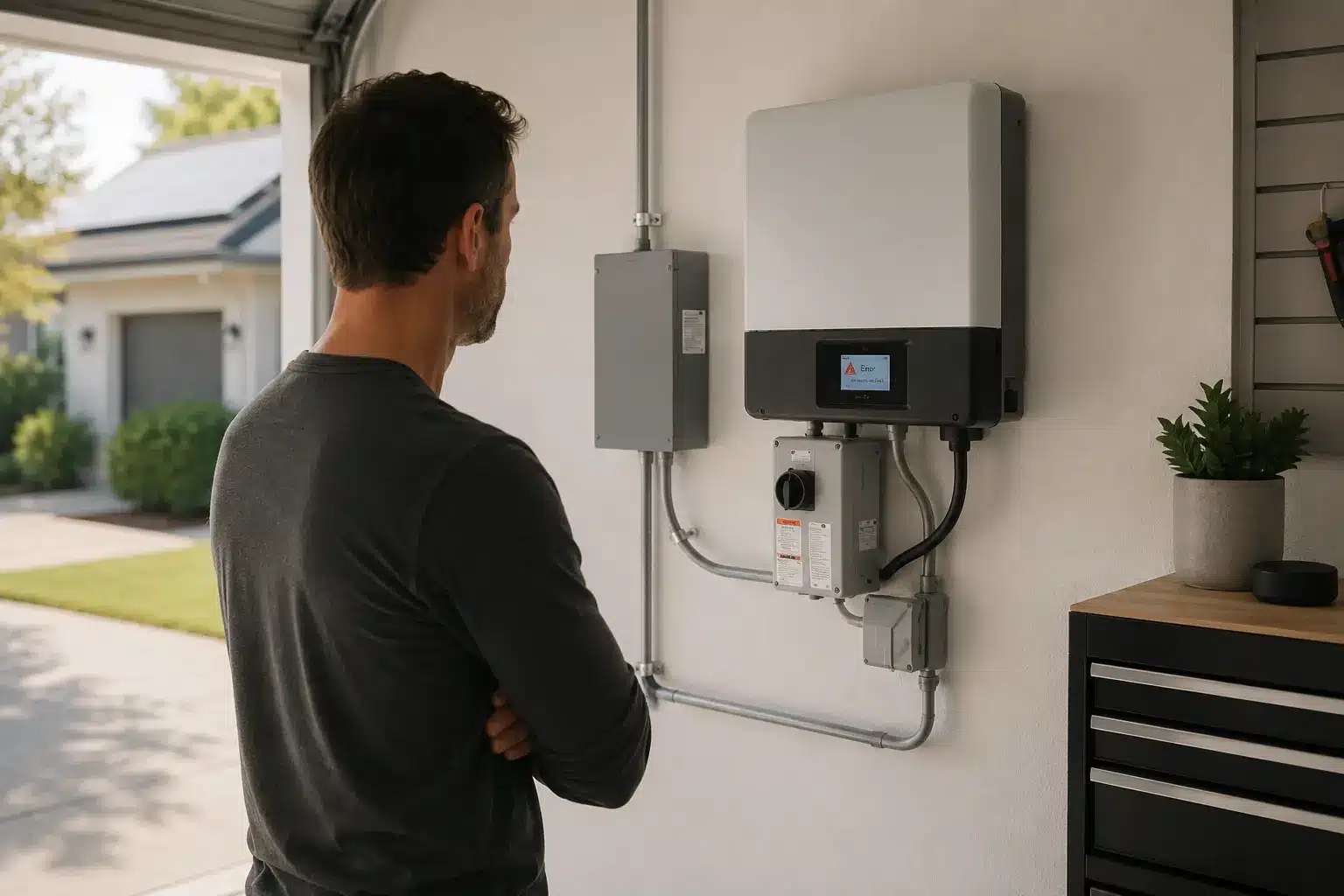
When your solar inverter fails, your entire system stops producing power. The monitoring app shows zero production, the inverter displays a red light or no light at all, and you’re suddenly drawing all your electricity from the grid. Here’s exactly what to do next — starting with the simple checks you can do yourself before calling anyone.
Step 1: Check the Obvious First
Before assuming the inverter itself has failed, rule out simpler causes. Start with your home’s main electrical panel. Look for any tripped breakers labeled for solar or the inverter. If you find one, flip it fully off, then back on. Check the inverter itself for any switches labeled AC disconnect or DC disconnect — these are emergency shutoffs that may have been turned off accidentally during electrical work or maintenance.
Next, check your monitoring app or portal. Does it show any specific error codes or fault messages? If so, write down the exact code. You’ll need it later. If the app shows nothing at all — the system appears completely offline — that’s a different diagnostic path than an inverter showing an active fault code.
Finally, look at the inverter display itself. Most inverters have LED indicators or a small screen. A solid red light, flashing red light, or completely dark display each mean different things. Take a photo of what you see. This visual record helps when you contact the installer or manufacturer.
Step 2: Confirm It’s Actually the Inverter
Solar systems have multiple points of failure. The inverter is the most common, but not the only one. If you have a string inverter system, a single failed panel or damaged wire can stop production even if the inverter is fine. If you have microinverters, one failed unit won’t stop the whole array — only that panel stops producing.
Check your monitoring data from before the failure. Did production drop suddenly to zero, or did it decline gradually over days or weeks? A sudden drop to zero during daylight hours almost always means inverter failure or a tripped disconnect. A gradual decline suggests panel soiling, shading issues, or individual microinverter failures.
Look at the weather. If it’s cloudy or raining, low production is normal. But if it’s a clear sunny day and your app shows zero production for several hours, the inverter is the most likely cause. If you’re not sure whether the issue is the inverter or something else, that’s fine — the installer will diagnose it. But these checks help you communicate the problem clearly when you call.
Step 3: Document Everything Before You Call
Warranty claims and service calls go faster when you have clear documentation. Before contacting your installer, gather this information: the exact date and time production stopped, any error codes or fault messages from the monitoring app, photos of the inverter display, and your system’s serial number (usually on a label on the inverter itself).
Log into your monitoring portal and take screenshots showing zero production during daylight hours. If the portal shows historical data, capture a screenshot from a recent day when the system was working normally for comparison. This proves the system was functioning before the failure and helps rule out user error or misunderstanding.
Find your installation paperwork. You need the installer’s contact information, the inverter manufacturer and model number, and the installation date. The installation date matters because most inverter warranties are 10-12 years from install date, not purchase date. If you can’t find the paperwork, check your email for the contract or final inspection report.
What to Expect When You Contact Your Installer
Response times vary widely. Reputable installers typically respond to service calls within 1-3 business days for diagnostics, faster if they have a dedicated service team. If your installer is still in business and you bought from a local company, expect a phone call or email within 24-48 hours. If you bought through a national installer or a company that has since been acquired, response may take longer.
The first call is usually diagnostic. The service tech will ask about error codes, when the system stopped working, and whether you’ve checked the disconnect switches. They may walk you through additional troubleshooting steps over the phone. If the inverter is clearly failed, they’ll schedule a site visit to confirm and begin the warranty claim process.
If your installer went out of business, you’ll need to contact the inverter manufacturer directly. Most manufacturers honor their warranties regardless of installer status, but the process is slower because they’ll assign an authorized service provider in your area rather than dispatching their own team. Expect 1-2 weeks for initial contact and 2-4 weeks for a site visit.
How Solar Inverter Warranty Claims Work
Most inverters carry a 10-12 year manufacturer warranty covering parts and a 10-year workmanship warranty from the installer covering labor. The manufacturer warranty is a true warranty — if the inverter fails due to defect, they replace it at no cost. The installer warranty covers the labor to remove the failed unit and install the replacement.
The claim process starts with the installer or authorized service provider confirming the failure on-site. They’ll document the issue, pull diagnostic logs from the inverter if possible, and submit a claim to the manufacturer with photos and serial numbers. The manufacturer reviews the claim, typically within 5-10 business days, and either approves a replacement or requests additional information.
Once approved, the manufacturer ships a replacement inverter to the installer or service provider. Shipping takes 1-2 weeks for in-stock models, longer if the model is discontinued and they’re cross-shipping a newer equivalent. The installer schedules the replacement appointment once the new unit arrives. Total timeline from failure to replacement: 3-6 weeks is typical. If parts are backordered, it can stretch to 8-12 weeks.
You pay nothing if the failure is within the warranty period and due to manufacturing defect. You may pay labor costs if the failure is outside the 10-year workmanship window but still within the manufacturer parts warranty. If the inverter was damaged by external causes — lightning strike, rodent damage, water intrusion from roof damage — the manufacturer warranty may not cover it, and you’ll pay for parts and labor unless your homeowner’s insurance covers it.
Temporary Options While You Wait for Repair
When your inverter fails, your solar panels sit idle and you draw all power from the grid. Your utility bill will return to pre-solar levels until the system is fixed. There’s no temporary workaround that lets you use solar power without a functioning inverter — the inverter is the only device that converts DC panel output to usable AC electricity.
If you have a battery storage system, whether it continues working depends on the system design. Most AC-coupled batteries (like Tesla Powerwall or Enphase IQ Battery) can continue charging from the grid and providing backup power even when the solar inverter is down. DC-coupled batteries tied to the same inverter as your panels will not work until the inverter is replaced.
Check your net metering balance if your utility uses annual reconciliation. If your inverter fails in summer when you normally overproduce, you may still have banked credits that offset your grid usage while the system is down. If it fails in winter when you’re already drawing from the grid, the financial impact is smaller since you weren’t producing much surplus anyway.
Document the downtime carefully. Some inverter warranties include production guarantees that compensate you for lost generation if repairs take longer than a specified timeframe. This is uncommon in residential warranties but worth checking your contract. More commonly, if the installer’s slow response causes unreasonable delay, you may be able to negotiate a goodwill credit or partial reimbursement for lost production.
When to Consider Replacing vs. Repairing
If your inverter is under warranty, replacement is automatic — the manufacturer sends a new or refurbished unit and the installer swaps it in. But if the inverter is out of warranty, you have a choice: pay for a direct replacement of the same model, or upgrade to a newer inverter with better features and a new warranty.
A replacement inverter costs $1,000-$3,000 depending on system size, plus $500-$1,500 labor. If your system is 12-15 years old and the inverter just failed, the panels are aging too. Replacing an out-of-warranty inverter with the same 10-12 year warranty model makes sense if you plan to keep the system for its full 25-30 year life. But if the system is already 15+ years old, a like-for-like replacement gives you a new warranty that may outlast the panels.
Upgrading to a newer inverter model may cost slightly more but gives you improved monitoring, better efficiency, and potentially smart home integration. If you’re considering adding battery storage in the future, upgrading to a hybrid inverter now (one that can manage both solar and batteries) avoids a second replacement later. Discuss this option with your installer before authorizing the warranty replacement if your system is more than 10 years old.
How to Prevent Future Inverter Failures
Most inverter failures are component defects that you can’t prevent. But you can extend inverter life by keeping it cool, dry, and clear of debris. If your inverter is in direct sunlight, in an unconditioned attic, or mounted in a location where temperatures regularly exceed 100°F, it’s working harder and will fail sooner. Inverters have thermal shutoffs that reduce output or shut down entirely when they overheat.
Check the inverter location during your annual system inspection. Make sure vents are clear, nothing is blocking airflow, and no rodents have nested nearby. If the inverter is in a garage or outdoor enclosure, check for water intrusion after heavy rain. Moisture and electronics don’t mix — even a small leak can corrode internal components over time.
Keep your monitoring app installed and check it periodically. Most inverters show warning signs before total failure — gradual efficiency decline, intermittent faults that clear themselves, or error codes that appear briefly then disappear. If you notice any of these patterns, contact your installer for a preemptive checkup. Catching a failing component before it stops production entirely can sometimes allow a scheduled repair rather than an emergency service call.
Finally, maintain a relationship with your installer. Even if the system is running fine, an annual checkup ensures they have current contact info and you have current emergency contact info for them. If they’ve been acquired or renamed, update your records. If they’ve gone out of business, research local solar service companies before you need one. Finding a qualified technician in an emergency is harder than finding one during normal business hours when you’re just planning ahead.
Finding Help If Your Installer Is Gone
If your original installer is no longer in business, you’re not out of options. Start with the inverter manufacturer’s website — most have a service provider locator tool where you can enter your ZIP code and get a list of authorized repair companies. These companies are trained on that manufacturer’s products and can handle warranty claims directly.
You can also use EnergyScout’s installer directory to find local solar companies that offer service and repair for systems they didn’t install. Filter by your location and look for companies that specifically mention service and O&M (operations and maintenance) in their descriptions. Call and ask whether they service your inverter brand and whether they’re authorized for warranty work on that manufacturer.
Expect to pay a diagnostic fee ($100-$300) if the company didn’t install your system. This fee covers the site visit and troubleshooting time. If they proceed with a warranty claim or paid repair, most companies will credit the diagnostic fee toward the total cost. If the inverter is out of warranty and needs replacement, get quotes from at least two service providers before committing — prices for out-of-warranty work vary more than warranty claim labor rates.
Frequently Asked Questions
Final Thoughts
An inverter failure feels like an emergency — your whole system stops producing and you’re suddenly paying full utility rates again. But in most cases, it’s a straightforward warranty claim with a predictable timeline. Document the failure clearly, contact your installer promptly, and expect a 3-6 week repair process if the unit is under warranty.
The bigger lesson: know who to call before something breaks. If your installer is still in business, keep their contact info current. If they’ve closed or been acquired, identify an authorized service provider in your area now, not when you’re staring at a red light on the inverter and zero production on your app. Solar systems are reliable, but every mechanical system eventually needs service. Having a plan makes the process faster and far less stressful.
If you’re researching solar and haven’t installed yet, this is one reason installer quality matters. A company that stands behind their work and responds quickly to service calls is worth more than the cheapest bid. Use EnergyScout’s directory to find installers with strong service track records in your area — the time to evaluate service quality is before you sign a contract, not after something breaks.