
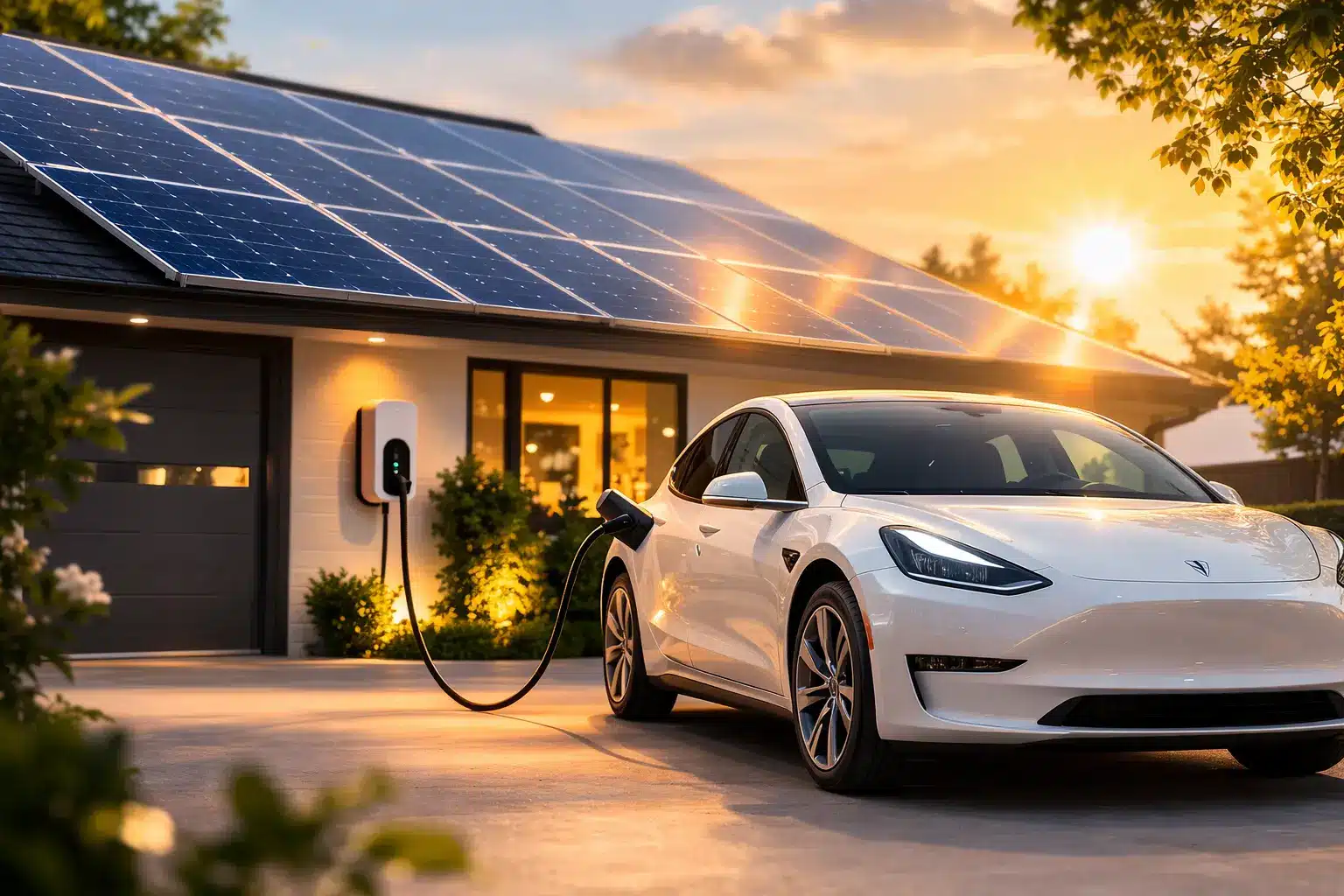
If you already have solar—or are thinking about going solar—buying an electric vehicle raises a natural question: how much of my roof needs to be dedicated to charging my car?
The answer depends on how much you drive and how efficient your vehicle is. But the math is simpler than most people expect, and for most homeowners, the answer involves far fewer panels than you might think.
For the typical American driver, 8–12 additional solar panels can generate enough electricity to power an EV for an entire year—turning your roof into a personal energy station that fuels both your home and your car.
Here’s how the numbers work.
The Quick Answer
For the average U.S. driver covering 12,000–15,000 miles per year:
- Annual EV electricity need: roughly 3,000–4,500 kWh
- Typical solar panel output: 400–600 kWh per panel per year
- Panels needed to cover EV charging: 8–12 for most drivers
Your exact number depends on four variables: how much you drive, your vehicle’s efficiency rating, your local sunlight conditions, and the wattage of your panels. We’ll break each one down below.
How Much Electricity Does an EV Use?
Electric vehicles measure efficiency in miles per kilowatt-hour (miles/kWh) rather than miles per gallon. Most modern EVs average about 3–4 miles per kWh, though this varies by vehicle model, terrain, and driving habits.
Using that range, here’s how annual mileage translates to electricity demand—and roughly how many solar panels would be needed to cover it:
|
Annual Mileage |
Electricity Needed (kWh) | Estimated Panels Needed* |
|
10,000 miles |
~2,500–3,300 kWh | 6–8 panels |
| 12,000 miles | ~3,000–4,000 kWh | 7–10 panels |
| 15,000 miles | ~3,800–5,000 kWh | 9–12 panels |
| 20,000 miles | ~5,000–6,700 kWh | 12–17 panels |
*Based on an average panel output of 450 kWh/year. Output varies by location and system design.
For context, the average U.S. home uses about 10,000–11,000 kWh per year. Adding an EV typically increases household electricity use by 25–40%—meaningful, but manageable with a properly sized solar system.
How Much Energy Do Solar Panels Produce?
A typical residential solar panel today is rated between 350–450 watts. But the figure that matters for sizing purposes is annual energy output—how many kilowatt-hours a single panel will produce over the course of a year.
In most U.S. regions, one solar panel produces between 400–600 kWh per year. That range reflects real differences in sunlight availability:
| Region | Avg. Peak Sun Hours/Day |
Est. Annual Output Per Panel |
| Southwest (AZ, NV, NM) | 5.5–6.5 hours | 550–650 kWh |
| Southeast / Mid-Atlantic | 4.5–5.5 hours | 450–550 kWh |
| Midwest / Great Plains | 4.0–5.0 hours | 400–500 kWh |
| Northwest / Northeast | 3.5–4.5 hours | 350–450 kWh |
A solar installer can model your specific roof orientation, shading, and local irradiance to give you a precise production estimate. The national average of ~450 kWh per panel per year is a reasonable starting point for planning.
Estimating Your Panel Count: A Step-by-Step Example
Let’s work through a concrete example.
- Driver covers 12,000 miles per year
- EV efficiency: 3.5 miles per kWh
- Annual electricity needed: 12,000 ÷ 3.5 = ~3,400 kWh
- Panel output (national average): 450 kWh per panel per year
- Panels needed: 3,400 ÷ 450 = ~8 panels
|
Bottom line: Most homeowners driving average mileage need 8–10 additional solar panels to cover their EV charging. Drivers with longer commutes or less efficient vehicles may need 12–15. |
A Note on Home EV Charging Equipment
Most EV owners charge at home using a Level 2 charger—a 240V unit typically installed in the garage. Level 2 chargers deliver 20–30 miles of range per hour of charging, compared to about 4–5 miles per hour from a standard 120V outlet.
Why does this matter for solar sizing? Level 2 chargers draw 7–11 kW while running. If you want your solar system to directly offset peak charging loads, your system size and inverter capacity both factor in—something a qualified installer can model for your specific setup.
For most homeowners, the practical goal isn’t real-time solar-to-EV charging. It’s generating enough annual solar production to offset what your EV draws from the grid over the course of the year.
How Solar Panels Actually Power Your EV
Your solar panels don’t charge your car directly in most cases. Instead, they generate electricity that flows into your home’s electrical system. Your EV charger then draws from that supply like any other appliance.
Because most EVs charge overnight—when solar panels aren’t producing—the relationship between solar and EV charging works through your utility account rather than in real time:
- During the day, your panels produce electricity and send excess to the grid
- Your utility credits that energy through net metering
- At night, your EV draws from the grid—but those credits offset the cost
In effect, solar powers your EV over time rather than in real time. The panels you install today can fuel your driving for 25–30 years—potentially through multiple vehicle upgrades.
Note: Net metering policies vary significantly by state and utility. Some programs offer full retail-rate credits; others compensate at a lower avoided-cost rate. Check your local utility’s current policy before sizing your system.
Sizing Your Solar System to Include EV Charging
Many homeowners choose to size their solar system upfront to cover both home electricity use and EV charging. This is generally more cost-effective than installing two separate systems over time.
A few factors that make this approach worthwhile:
- EV charging typically adds $500–$900 per year to a household electricity bill, depending on local rates and mileage
- Solar locks in a known cost per kWh for 25+ years, protecting against utility rate increases
- State-level incentive programs—including property tax exemptions, sales tax exemptions, and in some states, solar renewable energy credits (SRECs)—can meaningfully reduce system costs. Check what’s available in your state.
- If you already have solar, many systems can be expanded with additional panels if roof space and inverter capacity allow
The most important step is getting an accurate load estimate—both your current home usage and your projected EV mileage—before finalizing system size. A reputable installer will model both.
Frequently Asked Questions
Frequently Asked Questions
Not in most standard residential setups. Solar panels generate electricity that flows into your home’s electrical system, and your EV charger draws from that supply like any other appliance. Direct solar-to-EV charging is possible with specialized equipment, but most homeowners use net metering to balance solar production and EV consumption over time.
For most drivers, charging an EV adds $40–$80 per month depending on local electricity rates and how much you drive. At the national average electricity rate and 12,000 miles per year, expect roughly $50–$65 per month in added electricity costs.
No—most EV owners rely on net metering rather than batteries. Your solar system produces energy during the day, credits accumulate with your utility, and you draw from those credits when charging at night. Battery storage becomes more valuable if your utility has unfavorable net metering terms, if you want backup power, or if you’re trying to charge during grid outages.
Higher efficiency EVs stretch your solar production further. Models with ratings above 4 miles per kWh—like the Tesla Model 3 Long Range, Hyundai Ioniq 6, or Lucid Air—require fewer panels to cover annual charging than less efficient models. EPA efficiency ratings are a useful comparison point when evaluating vehicles.
Drivers covering 20,000+ miles annually will need a proportionally larger system—typically 12–17 panels just for EV charging, on top of panels for home electricity use. If you drive significantly more than average, make sure your installer models your actual mileage rather than defaulting to national averages.
Often yes—many solar systems can be expanded if roof space is available and your existing inverter has capacity for additional panels. If your original system was sized conservatively, adding 8–12 panels for EV charging may be straightforward. Ask your original installer about expansion capacity before assuming an add-on is simple; some inverter configurations require an upgrade.
Final Thoughts
Solar and electric vehicles are a natural pairing. Your roof can become a personal energy station—generating the electricity that powers your home, your car, and potentially the vehicles you’ll own decades from now.
For most drivers, covering EV charging requires fewer panels than expected. The math is straightforward, and the long-term economics tend to be compelling once you account for both electricity cost offsets and state incentive programs.
Understanding your own driving habits and your local solar production potential is the right starting point—and the right installer will help you model both before you commit.